Advertisement
Here is the long-form, storytelling-driven article you requested.
Article Begins
Let’s talk about Ramesh.
Ramesh runs a small, thriving nursery on the outskirts of Nashik. He’s good at what he does. His plants are healthy, and his customers—landscapers, homeowners, and local builders—are loyal.
But Ramesh has a problem. A three-wheeled, rumbling, gas-guzzling problem.
His trusty 3-wheeler auto-rickshaw, which he bought second-hand, is costing him his business.
Every morning, he has a big delivery for a construction site: 200 potted plants and 10 bags of soil. His 3-wheeler can’t handle the weight. It’s a 500 kg load, max. So, Ramesh has to make two trips.
That’s double the diesel. Double the time. Double the driver cost.
On the highway, he’s dangerously slow, with trucks roaring past. On the ghat (mountain pass) leading to the site, he’s in first gear, the engine screaming, praying it doesn’t overheat.
He’s stuck. He’s making a small profit, but he can’t grow. He can’t take on that second big client because his one vehicle is busy all morning doing a single client’s work.
He’s afraid of the next step. A “real” truck sounds expensive. The EMI, the higher diesel cost, the maintenance—it’s a risk he’s not sure he can take.
This story—Ramesh’s story—is the story of millions of small businesses in India. They are trapped in the “missing middle” of logistics: too big for a 3-wheeler, but too small for a heavy-duty pickup.
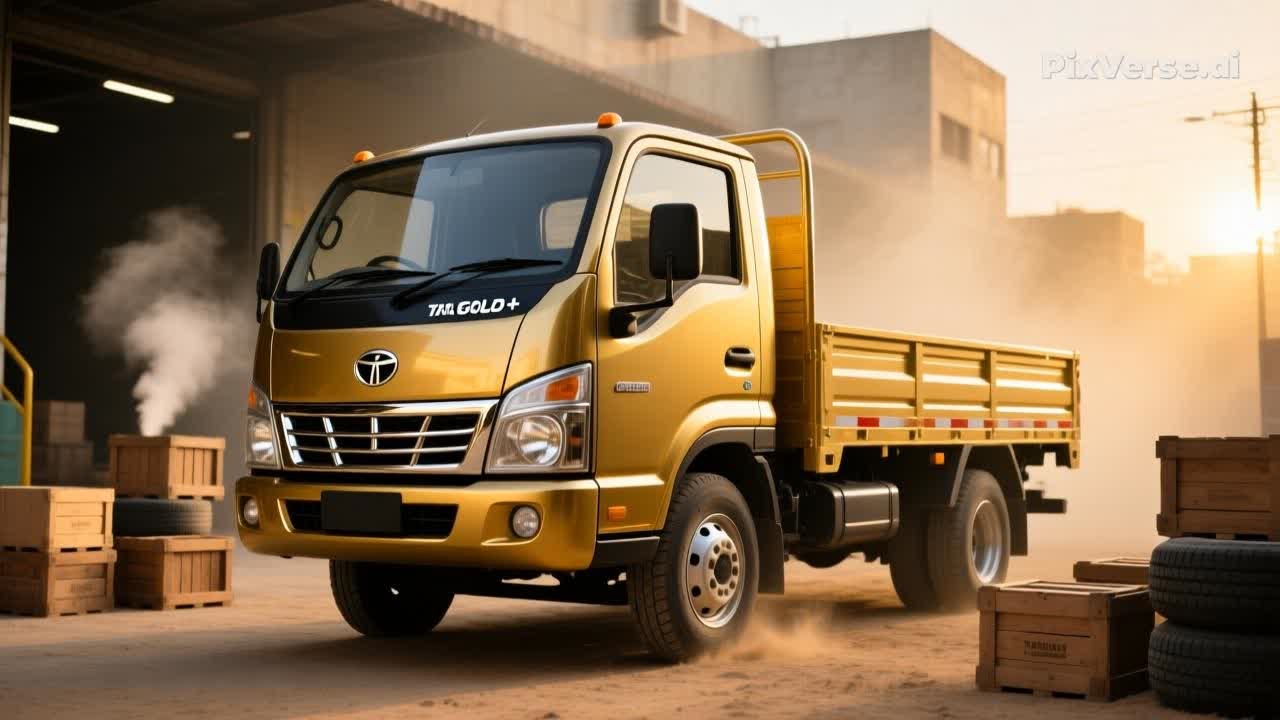
And that is why the new Tata Ace Gold+ diesel matters.
It’s not just another mini-truck. It’s not just a facelift of the “Chota Hathi.”
It is a specific, engineered solution to Ramesh’s exact problem. It’s a 4-wheeled business plan, designed to be the single most important investment a small entrepreneur can make. This article isn’t a simple review; it’s a breakdown of why this machine is the new king of the affordable logistics segment.
The “Chota Hathi” Grew Up: Why We Needed a “Plus”
For over 15 years, the Tata Ace has been more than a truck. It’s an icon. It’s the “Chota Hathi” (Little Elephant) that created the entire small commercial vehicle (SCV) market.
It gave millions of 3-wheeler drivers a path to dignity, safety, and higher earnings.
But India has changed.
- BS6 emission norms made engines more complex.
- Diesel Exhaust Fluid (DEF), or AdBlue, became a new, expensive, and annoying hassle for drivers.
- Roads got better, meaning customers expected faster deliveries.
- Fuel costs went through the roof, making mileage the single most important factor.
The original Ace was a legend, but the game got harder. Small business owners like Ramesh needed something that wasn’t just reliable, but highly profitable. They needed more power to make faster trips, but also better mileage. They needed a higher payload to make one trip, not two.
And they hated the AdBlue hassle.
Tata listened. The “Plus” in Tata Ace Gold+ diesel isn’t a sticker. It’s a promise. It means:
- More Power: To climb hills and cut trip times.
- More Payload: To do one trip, not two.
- More Mileage: To save money on every single kilometer.
- More Reliability: With less complex maintenance.
This is the new formula. And it’s a masterpiece of engineering for the affordable logistics segment.
The 5-Point Profitability Test: How the Ace Gold+ Diesel Makes You Money
When you own a commercial vehicle, you don’t care about “cool features.” You care about earning. Every feature must answer one question: “How does this make me more money?”
Let’s put the Ace Gold+ to the test.
1. The “Kitna Deti Hai?” Question: Mileage & Total Cost of Ownership
This is the first and last question everyone asks. The Tata Ace Gold+ diesel mileage is a claimed 22-23 kmpl.
This is a staggering number for a vehicle this powerful. How do they do it?
- New Engine Tech: It has a new 2-cylinder, 702cc turbocharged engine. But the real magic is the new 5-speed, Direct Drive Gearbox. It’s smoother, reduces vibration, and is perfectly tuned to keep the engine in its most fuel-efficient “sweet spot.”
- The “Eco” Switch: The Ace Gold+ has two modes. A “Power” mode for heavy loads and hills, and a “City” (or Eco) mode for lighter loads or city traffic. This simple switch lets your driver actively save fuel.
But the real genius isn’t the mileage. It’s the Total Cost of Ownership (TCO).
This is the biggest headache of the BS6 era. Most new diesel trucks require Diesel Exhaust Fluid (DEF) / AdBlue. It’s an extra fluid you have to buy, store, and refill. If you run out, your truck can stop. It’s a costly, time-wasting hassle.
The Tata Ace Gold+ DOES NOT NEED DEF.
It uses an advanced Lean NOx Trap (LNT) technology to meet emission norms without AdBlue. For a small operator, this is a massive win. It means:
- No extra cost for AdBlue.
- No time wasted refilling it.
- No risk of your truck stopping because a sensor failed.
This one feature alone makes it a low-maintenance mini-truck champion, slashing your running costs and keeping your vehicle on the road, earning.
2. The “One-Trip” Solution: The 900 kg Payload
Let’s go back to Ramesh and his two-trip nightmare.
The old 3-wheeler auto? Its payload is ~500 kg.
The new Tata Ace Gold+ diesel? Its payload is 900 kg.
This is not a small upgrade. It is a complete business model transformation.
Ramesh’s 700+ kg load of plants and soil that used to take two trips? He now does it in one.
- His fuel cost for that job is cut in half.
- His driver’s time for that job is cut in half.
- His vehicle is back at the nursery by 10 AM, ready for a second big delivery.
He hasn’t just bought a truck; he has bought back his own time. He can now double his business without buying a second vehicle. The 7.2-foot-long cargo body is wide, flat, and easy to load. This 900 kg payload is the single biggest “profit-multiplier” on the spec sheet.
3. The “Ghat-Climbing” Engine: Power That Earns You Time
“Power” sounds like an expense. For a commercial vehicle, power is an income-generating tool.
The Ace Gold+ has a 2-cylinder, 702cc turbocharged engine that is a beast.
- Power: 22 HP (in Power Mode)
- Torque: 55 Nm
“Torque” is the pulling power of the engine. 55 Nm is huge for this category. What does this mean in the real world?
It means when Ramesh hits that steep ghat with his 900 kg load, the engine doesn’t scream. It just pulls. He doesn’t drop to first gear; he confidently climbs in third.
Faster Trips = More Trips.
In the last-mile delivery solution business (like e-commerce, vegetables, or water delivery), speed is money.
- A faster pickup (32% better acceleration) means you get ahead in city traffic.
- A higher top speed (65 kmph) means you spend less time on highways.
- Climbing a flyover fully loaded doesn’t slow you down.
If you can shave 10 minutes off every trip, you can fit one entire extra trip into your day. That’s pure profit, unlocked by a more powerful engine.
4. The Driver is Your Business Partner (A Happy Driver is a Profitable Driver)
This is the most overlooked part of the affordable logistics segment. We give our drivers cheap, uncomfortable, bone-jarring machines and then wonder why they drive rashly, get tired, or quit.
A tired driver misses deadlines, has accidents, and burns more fuel.
The Ace Gold+ has an ergonomic cabin. It’s not a luxury car, but it’s a huge step up from a 3-wheeler or an older-gen truck.
- Ergonomic Seats: They are more comfortable and have headrests.
- Less Effort: The new steering requires 35% less effort to turn. The new gearbox is smoother.
- Less Noise: The cabin is quieter and has fewer vibrations (low NVH).
- Convenience: It has a digital instrument cluster, a lockable glovebox, and a USB charging port.
That USB port isn’t a “feature.” It means your driver’s phone (with Google Maps) never dies. That comfortable seat isn’t a “luxury.” It means your driver is still alert and productive on their 8th delivery of the day.
Investing in driver comfort is a direct investment in your business’s efficiency.
5. Uptime is Everything: The “India-Proof” Reliability
A small commercial vehicle doesn’t get weekends off. It must run, every single day. A truck that is in the garage is a truck that is costing you money.
This is where the Tata Ace legend was born, and the Gold+ builds on it.
- Simple, Tough Engine: The 2-cylinder engine is a known quantity. It’s simple, and any mechanic in any village in India knows how to fix it.
- Strong Suspension: It uses rugged parabolic leaf springs in the front and semi-elliptical leaf springs in the back. This is built to be overloaded. It’s built for kaccha roads. It’s built to last.
- Peace of Mind: The Ace Gold+ comes with a 3-year / 100,000 km warranty. This is a powerful guarantee. It means Tata stands behind this engine, and your maintenance costs are predictable for the first three years.
- Tata’s Service Network: You are never far from a Tata service center. This massive network means less downtime, faster repairs, and easy availability of genuine parts.
When you buy an Ace, you’re not just buying a truck; you’re buying into the largest commercial vehicle ecosystem in India.
The Big Question: In an Age of EV & CNG, Why Diesel?
This is the elephant in the room. With the Tata Ace EV and Ace CNG available, why would anyone buy a diesel mini-truck in 2026?
The answer is simple: Horses for courses.
The Case for CNG (Ace Gold CNG)
CNG is fantastic. It’s cheaper to run, per-kilometer, and it’s cleaner.
- Best For: E-commerce or food delivery inside a major city (like Delhi, Mumbai, Pune) where you have 100% CNG pump availability and your daily run is predictable.
- The Catch: CNG engines have less power and torque. Load one up with 900 kg and try to climb a hill—you’ll feel the struggle. And if your business is in a Tier-2 or Tier-3 city, finding a CNG pump can be a daily headache.
The Case for Electric (Tata Ace EV)
The Ace EV is the future. It’s silent, has zero fuel cost, and is incredibly powerful (130 Nm of torque!).
- Best For: “Last-mile-only” logistics with a fixed route. A company that can leave it to charge all night at its own depot and run it for 80-100 km during the day.
- The Catch: Range anxiety is real. You can’t just “top it up” in 5 minutes. The initial purchase price is higher. It is not yet the “go-anywhere, run-all-day” workhorse.
The Undefeated King: Diesel
Diesel is the king of torque and the king of range.
The Tata Ace Gold+ diesel is for the unpredictable business.
- It’s for Ramesh, who has to go to a rural site one day and a city center the next.
- It’s for the fruit supplier who has to drive 100 km to a mandi at 3 AM.
- It’s for the transporter in a hilly region where pulling power (torque) is non-negotiable.
Diesel gives you the power to carry your full 900 kg payload, the torque to climb any hill, and the ability to refuel in 5 minutes, anywhere in India. For the ultimate combination of flexibility, power, and range, diesel is still the undisputed champion for the affordable logistics segment.
The Showdown: Ace Gold+ vs. The Competition
This is where the high CPC keywords come into play. How does it stack up?
Tata Ace Gold+ Diesel vs. Mahindra Jeeto
The Jeeto is a worthy competitor, often praised for its high mileage.
- Jeeto: Has a 1-cylinder engine, lower payload (around 715 kg), and lower torque (around 45-48 Nm).
- Ace Gold+: Has a 2-cylinder engine, much higher 900 kg payload, and significantly more torque (55 Nm).
The Verdict: The Jeeto is a good light-duty truck. But the Ace Gold+ is the superior earning machine. That extra ~200 kg of payload and extra pulling power means you can take more profitable jobs that the Jeeto would have to pass on.
Tata Ace Gold+ Diesel vs. Ashok Leyland Dost
This is a different comparison. The Dost is often a step up in size, with a 3-cylinder, 80 HP engine and an even higher payload.
- Dost: A fantastic truck, but it’s bigger, more expensive, and has a wider turning radius. It’s less of a “last-mile” specialist.
- Ace Gold+: The Ace is the surgeon of city logistics. Its key advantage is its compact size and tiny 4.3-meter turning radius. It can dive into a narrow galli (alley), a crowded mandi, or a tight apartment basement—places the larger Dost can’t go.
The Verdict: If you only do light-highway transport, the Dost is a great choice. If your business lives and dies in the chaos of Indian city traffic, the Ace Gold+ is the more agile, affordable, and practical tool.
The Final Calculation: Your First Step to a Bigger Business
Let’s go back to Ramesh.
He’s not just buying a truck for Rs. 5.99 lakh (ex-showroom). He’s making an investment.
He can get a Tata Ace loan with a low down payment, and his monthly EMI will be affordable (around Rs. 12,000-14,000).
But here’s the magic:
- By doing one trip instead of two, he saves Rs. 400-500 per day in fuel and driver costs. That’s Rs. 12,000-15,000 per month.
- The truck literally pays its own EMI.
- And because his truck is free by 10 AM, he can now take on that second big client. That’s 100% new profit.
This is why the Tata Ace Gold+ diesel matters. It’s not a “Chota Hathi” anymore. It’s a “Profit Ladder.”
It is the most reliable, affordable, and accessible tool for an ambitious entrepreneur to climb from “small-time” to “professional.” It eliminates the hassle of DEF, destroys the “two-trip” problem with its 900 kg payload, and saves you money on every single trip with 22 kmpl mileage.
The question isn’t “Can you afford to buy a Tata Ace Gold+?”
The real question is: “Can you afford to keep losing money with a 3-wheeler while your competitor buys this?”
Stop Making Two Trips. Start Making More Profit.
Your business is ready to grow. Your vehicle shouldn’t be the thing holding you back.
It’s time to feel the power of 55 Nm of torque and the savings of 22 kmpl. It’s time to see what your business could be.
Click the link below to find the latest on-road price for the Tata Ace Gold+ diesel in your city, check out the latest low-EMI finance offers, and book a test drive today.