Advertisement
Let’s talk about Randeep.
Randeep Singh owns a mid-sized logistics fleet in Bhiwandi. For 20 years, his business has run on two things: diesel and driver intuition. His 30-truck fleet, mostly older BS4 and a few new BS6 Tata Signas, is his life.
But Randeep is stressed.
His diesel bills are spiraling out of control. The government’s new emission norms mean more compliance headaches. His best drivers are complaining about fatigue on 600km routes, and a “minor” accident last month cost him a fortune in downtime and repairs.
He’s stuck. Buying another old-school diesel truck feels like putting a band-aid on a bullet wound. But what’s the alternative?
Randeep, like thousands of fleet owners across India, isn’t just looking for a “new truck.” He’s looking for a new answer.
He’s heard the whispers from factory floors and seen the spy shots from the test tracks. Something big is coming from Tata Motors in 2026. And it’s not just a new grille or a bigger engine.
It’s a complete revolution.
If you think 2026 is just about another model update, you’re about to miss the biggest shift in Indian logistics history. We’ve dug through the concepts, analyzed the pilot programs, and listened to the industry insiders.
This is your sneak peek into the upcoming Tata truck models for 2026. And trust me, it’s not just about what these trucks are. It’s about what they do for your bottom line.
Why 2026 is a “Big Bang” Moment for Tata Trucks
First, you need to understand why this is happening now.
In 2025, Tata Motors made a huge corporate move. They demerged their commercial vehicle (CV) business into its own powerful, focused entity.
Think of it like this: For years, Tata’s truck division was a big, important part of a giant family. Now, that division has moved into its own house, with its own budget, and a single, obsessive goal: to build the future of Indian commercial transport.
This 100% focus means more R&D, faster innovation, and a lineup that’s built specifically to solve Randeep’s problems.
The 2026 lineup is the first-born child of this new, hyper-focused company. And it’s built on three pillars that will change everything.
Pillar 1: The “Zero Emission” (ZET) Revolution
The biggest 2026 story is the sound of silence. The rumble of diesel is being replaced by the hum of electric motors. Tata’s “Zero Emission Trucks” (ZET) strategy is moving from “concept” to “commercial” reality.
This isn’t a “one-size-fits-all” approach. It’s a targeted attack.
For Urban Freight & Last-Mile: The Ultra E.12
For businesses doing “hub-and-spoke” deliveries within a city (like e-commerce, groceries, or FMCG), diesel is a dying king. It’s loud, polluting, and expensive to run in stop-and-go traffic.
The 2026 Sneak Peek: Enter the Tata Ultra E.12 and its brethren. Based on the concepts showcased at the 2025 Bharat Mobility Expo, this is a purpose-built urban freight solution.
- The “Why”: It’s designed to run a full 10-12 hour shift within a city, return to the depot, and recharge overnight.
- The Analogy: It’s like switching from a bulky, gas-guzzling generator to a silent, efficient inverter. The Total Cost of Ownership (TCO) is the killer feature.
- What it Solves for Randeep: His “last-mile” contracts become wildly profitable. Fuel costs (electricity) are a fraction of diesel, and maintenance plummets. An EV has almost no moving engine parts to service.
For Heavy-Duty & Short-Haul: The Prima E.55S & E.28T
This is the one that’s already hitting the road. In late 2025, Tata began delivering the Prima E.55S electric prime mover, making it the flagship of the 2026 EV fleet.
- The 2026 Sneak Peek: This is a beast. It’s a 55-tonne prime mover designed for short-to-medium-haul routes (think: port-to-warehouse, or factory-to-distribution-hub).
- The Specs that Matter:
- Real-World Range: Around 300-350 km on a single charge.
- Dual-Gun Fast Charging: This is key. It can be juiced up quickly during loading/unloading.
- Advanced Features: It comes loaded with ADAS (we’ll get to that) and a state-of-the-art cabin.
- What’s Next? Look for the Prima E.28T (Coming Soon) to fill the gap just below it, creating a full family of heavy electric trucks.
This is Tata’s answer to the “clean port” and “green logistics” mandates that are becoming law.
Pillar 2: The “Alternate Fuel” (AFT) Gamble: Beyond Electric
Here’s the honest truth: Electric isn’t the answer for everyone. What about Randeep’s 600km long-haul routes from Delhi to Lucknow? You can’t stop for a 3-hour charge.
This is where Tata’s 2026 strategy gets really smart.
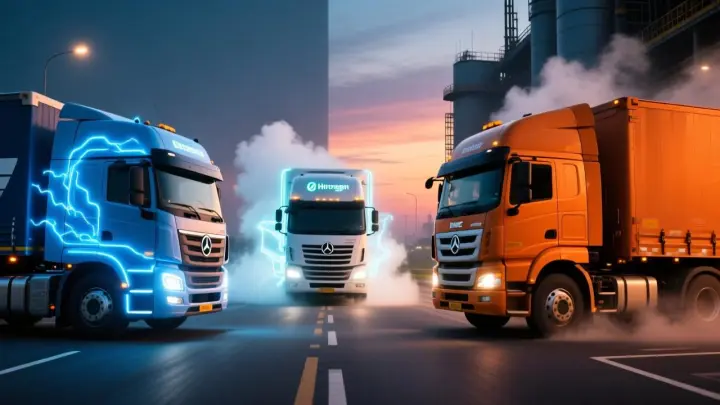
The Hydrogen Hope (H2): Prima H.28 & H.55S
This is the biggest story for 2026-2027. Tata is all-in on hydrogen, and their pilot programs (which started in 2025) are set to become commercial reality.
They are attacking this from two directions:
- H2-ICE (Hydrogen Internal Combustion Engine):
- What it is: This is the “easy” transition. It’s a truck that burns hydrogen in an engine that’s very similar to a traditional diesel engine.
- The 2026 Sneak Peek: The Prima H.28 is the poster child.
- Why it’s Brilliant: Your existing mechanics will understand it. It’s a familiar technology, just with a new fuel. It’s the perfect “bridge” for fleet owners.
- H2-FCEV (Hydrogen Fuel Cell Electric Vehicle):
- What it is: This is the true zero-emission tech. It uses a hydrogen fuel cell to create electricity on board, which then powers an electric motor.
- The 2026 Sneak Peek: The Prima H.55S (FCEV) is the long-haul hero.
- The Analogy: It’s an electric truck with its own “mini-power-plant.” It offers the silent, powerful drive of an EV but with a 5-10 minute refueling time (just like diesel) and a massive range.
Girish Wagh, the head of Tata Motors, has been clear: they expect a commercial launch for these hydrogen trucks within 12-24 months. That means 2026 is the year you’ll be able to order one.
The LNG & CNG Workhorses
Don’t forget the “other” alternate fuels. For routes where hydrogen isn’t available, Tata is doubling down on LNG (Liquefied Natural Gas) for its long-haul Prima models (like the Prima 3530.K LNG) and CNG for its entire LCV/ICV range.
The 2026 takeaway: It’s not “Diesel vs. Electric.” It’s about a “multi-fuel” portfolio. You’ll be able to choose the exact right fuel for the exact right route, optimizing your TCO for every single truck.
Pillar 3: The “Digital Co-Pilot”: Smart Trucks, ADAS & the 2026 Prima
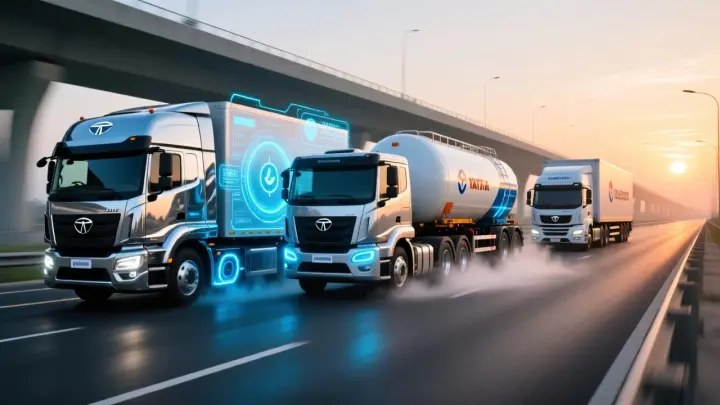
This might be the most important update for Randeep’s business. The 2026 models are not just “trucks.” They are “data centers on wheels.”
For years, “premium” in a truck meant an AC cabin. For 2026, “premium” means safety and intelligence.
The 2026 Tata Prima: A “Mobile Office” Redesigned
Forget the old, bouncy cabins. The first “unveils” of the 2026 Tata Prima (Result 1.2) show a completely redesigned, aerodynamic, and driver-focused cabin.
- Why it Matters: Driver retention. A comfortable, quiet, and ergonomic cabin means your driver is less fatigued, safer, and happier. They are less likely to quit.
- The Analogy: You’re upgrading your driver from a tool-shed to a modern, sound-proofed office. This is a massive productivity and safety boost.
ADAS is Now Standard (The “Secret Weapon”)
This is the game-changer. Tata is integrating ADAS (Advanced Driver-Assistance Systems) across its 2026 Prima and Signa lineups. This isn’t a gimmick; it’s a balance-sheet savior.
Look for these features to become the new standard:
- Collision Mitigation System (CMS): Automatically brakes the truck if it detects a likely forward collision. This alone can prevent the “minor” accident that cost Randeep a month of profit.
- Lane Departure Warning (LDW): Alerts a sleepy driver if they are drifting out of their lane.
- Driver Monitoring System (DMS): A camera inside the cab that watches the driver for signs of drowsiness or distraction.
What this Solves: This is your “digital co-pilot.” It protects your driver, your cargo, and your truck. For Randeep, this means lower insurance premiums, dramatically less downtime, and a safer fleet.
2026 Sneak Peek: The LCV & Pickup Revolution
It’s not all about the big boys. The “last-mile” and rural-transport segments are getting a massive overhaul.
H3: The 2026 Tata Yodha: Tough Gets Smarter
The Yodha is the king of the rural-urban pickup space. The 2026-bound model (Result 1.1) is a ground-up update.
- The 2026 Sneak Peek: A “tougher, smarter, more capable” Yodha.
- What to Expect:
- A bold, “muscular” front fascia with modern LED lighting.
- Improved Suspension: A huge deal for handling heavy loads on bad roads.
- A more premium, car-like interior.
- Who it’s for: Farmers, small business owners, and construction crews who need a reliable workhorse that doesn’t feel like a penalty box to drive.
The “X-Factor”: The Intra EV & The Sierra Pickup
This is where the lines blur. The Tata Intra EV is already proving to be a last-mile champion. But the concepts for 2026 are even wilder.
We’ve all seen the Tata Sierra EV (the passenger car). But Tata has also shown a Sierra Pickup concept (Result 1.3).
- The 2026 Sneak Peek: A dual-motor, all-wheel-drive electric lifestyle pickup with a potential 500km range.
- Why it Matters: While it seems “lifestyle,” this platform could easily be adapted for premium commercial use (think: a site supervisor’s vehicle, a premium airport transport). It shows that Tata’s EV tech is scaling across all segments.
Objections & Honest Questions for 2026
Let’s put the hype aside and talk reality. Randeep is a practical man, and he has two big questions.
1. “Are you telling me my diesel trucks are worthless?”
No. Absolutely not.
The 2026 lineup isn’t replacing diesel; it’s adding options. The new BS6 Phase 2+ diesel engines (like in the current Prima 5532.S) are the cleanest, most fuel-efficient diesel powerplants Tata has ever made.
For the undefined, super-long-haul routes where no charging or hydrogen exists, a new 2026 diesel Prima will still be the king. The 2026 strategy is about “horses for courses.” You’ll now have the choice to optimize.
2. “These EV & Hydrogen trucks will be crazy expensive. I can’t afford a ‘science project’.”
This is the most important conversation: Sticker Price vs. Total Cost of Ownership (TCO).
Yes, the initial purchase price of a Prima E.55S or Prima H.28 will be significantly higher than a diesel truck. You’re buying a lot of advanced battery and fuel cell technology.
But the sticker price is the wrong number to look at.
TCO is the only number that matters.
- Fuel Costs: Electricity (especially if you install solar at your depot) is dramatically cheaper per-kilometer than diesel.
- Maintenance Costs: An electric motor has a tiny fraction of the moving parts of a diesel engine. No oil changes, no filters, no complex gearbox. Maintenance costs will plummet.
- Incentives: The government’s FAME scheme and other green-tech incentives will cut that initial sticker price down.
- Uptime: Less time in the workshop means more time on the road, earning you money.
A 2026 electric or hydrogen truck is not a “cost.” It’s an “investment.” It’s a machine designed to save you money every single kilometer it drives.
The Final Verdict: Is 2026 the Year You Rethink Your Fleet?
Let’s go back to Randeep.
His problems—high fuel costs, driver fatigue, safety, and downtime—are exactly what Tata’s 2026 lineup is designed to solve.
The upcoming Tata truck models are not just trucks. They are a toolkit of business solutions.
- Got a high-traffic city route? The Ultra E.12 will make it your most profitable one.
- Got a 300km hub-to-hub run? The Prima E.55S is your cash-cow.
- Worried about driver safety and accidents? The new Prima with ADAS is your insurance policy.
- Ready to future-proof your long-haul business? The Prima H.28 (Hydrogen ICE) is your first step.
The 2026 sneak peek is clear: Tata Motors is giving you a choice. You can no longer afford to buy “just a truck.” You have to buy the right truck for the right job.
And for the first time, from electric to hydrogen to smart-diesel, Tata has an answer for all of them.
Don’t Wait for 2026 to Start Your Plan
The future of logistics is about matching the right technology to the right route. But how do you know if an EV, Hydrogen, or advanced Diesel truck is right for your business?
You don’t have to guess.
Our team of commercial vehicle experts can help you analyze your current routes, your fuel expenses, and your downtime costs. We’ll build a Free, No-Obligation Total Cost of Ownership (TCO) Analysis to show you exactly how and if one of these new 2026 platforms can save you money.
Stop worrying about rising diesel prices. Start building a smarter, more profitable fleet.