Advertisement
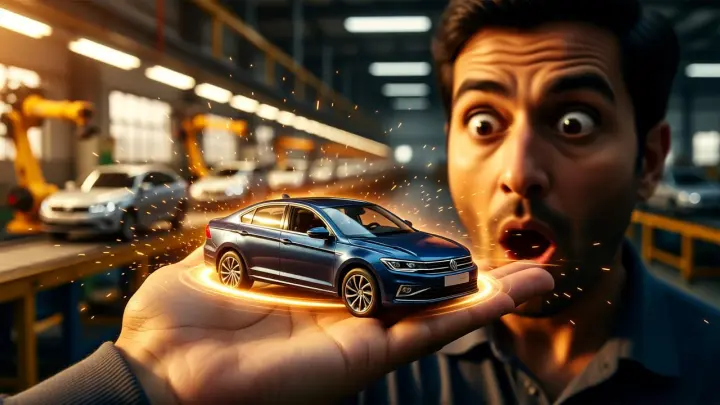
Let’s talk about Rajesh.
Rajesh is a 38-year-old IT manager from Bangalore. He’s been saving for two years, his family has grown (he now has a 6-year-old and a new baby), and his trusty 8-year-old hatchback just isn’t cutting it. It’s time for the “big” family car. The 10-year+ investment.
He’s narrowed it down to two brands, and he is completely stuck.
On one side is the new 2025 Tata Safari. He took a test drive. He was blown away. The 12.3-inch screen, the panoramic sunroof, the ventilated seats, the Level 2 ADAS that steered itself… it felt, he told his wife, “like a car from the future.” And with Tata’s 5-star Bharat NCAP safety rating, he knows his family would be secure.
On the other side is the 2025 Toyota Innova Hycross. He test-drove it right after. It… didn’t have the same “wow” factor. The screen was smaller. The interior felt durable, but less “premium” than the Tata’s. But it was a Toyota. It was an Innova. His father-in-law, a practical man, put it simply: “You buy a Toyota, you buy peace of mind. It will run for 15 years, and you’ll still sell it for a good price.”
Rajesh’s heart is with the Tata. Its features, its style, its “Made in India” pride.
His head is with the Toyota. Its reliability, its legendary after-sales service, its iron-clad resale value.
This isn’t just Rajesh’s problem. This is the single biggest dilemma for the premium car buyer in India today. It’s the “New Age Tech” vs. the “Old School Reliability.”
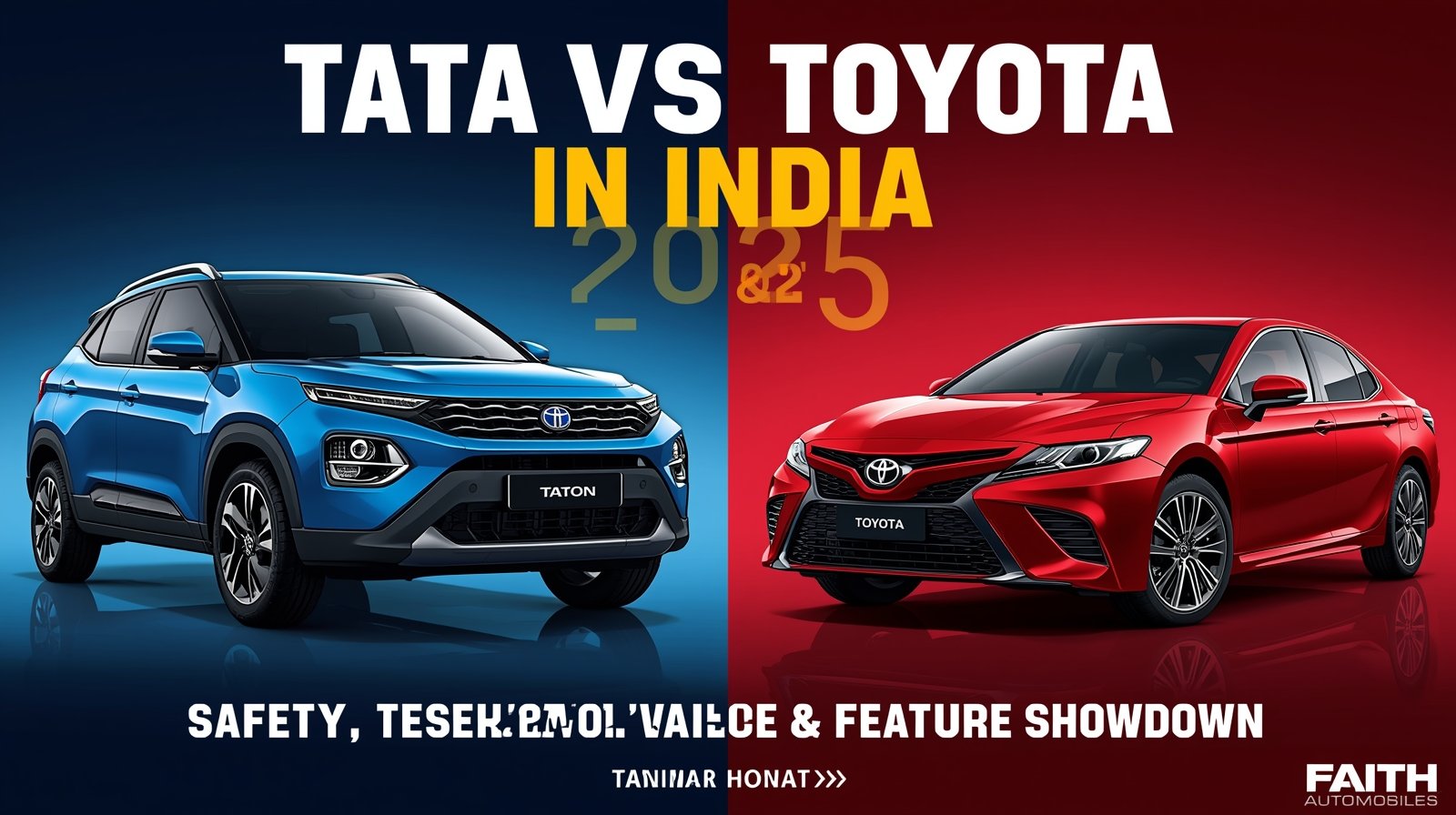
It’s Tata vs. Toyota.
For years, this wasn’t a fair fight. Tata was the budget option with question marks. Toyota was the gold standard. But it’s 2025, and the game has completely changed. Tata is no longer just “good for an Indian brand.” It’s a global contender.
So, who really wins in the 2025 showdown? We’re going to settle the debate. We’ll dive deep into the three things that actually matter for a long-term family car: Safety, Resale Value, and Features.
Pillar 1: The Safety Showdown (The 5-Star Surprise)
For a family man like Rajesh, this is non-negotiable. For decades, “safety” in India meant “big.” If a car was heavy, we assumed it was safe.
Not anymore.
Tata: The King of Crash Tests
Let’s be blunt: Tata Motors is arguably the single most important company in mainstreaming car safety in India.
They set the trend by sending their cars—even affordable ones like the Nexon—to Global NCAP and aiming for 5-star ratings. They made “5-Star Safety” a marketing slogan, and it worked.
In 2025, this legacy is stronger than ever.
- Tata Nexon (BNCAP): 5-Star (Adult & Child)
- Tata Altroz (GNCAP): 5-Star (Adult)
- Tata Harrier & Safari (Bharat NCAP): A full 5-Star rating.
When the new 2025 Tata Safari and Harrier were tested by India’s own Bharat NCAP, they scored 5 stars for both adult and child protection, setting one of the highest scores in the country. This isn’t just marketing; it’s a core engineering philosophy.
Toyota: The Silent Guardian
Toyota’s brand was built on QDR (Quality, Durability, Reliability), not crash test scores. They never “marketed” safety the way Tata did, because they assumed you knew a Toyota was built like a tank.
But assumptions aren’t data. How do they really stack up?
- Toyota Innova Hycross (Bharat NCAP): A full 5-Star rating.
- Rebadged Models (Glanza, Taisor): Their Suzuki counterparts (Baleno, Fronx) have seen massive safety improvements, with new models aiming for (and achieving) 4 and 5-star ratings.
When the Innova Hycross—the Safari’s direct rival—was put through the Bharat NCAP wringer, it also came out with a perfect 5-star rating.
The Verdict on Safety
This is a tie. And it’s the best news possible for Indian consumers.
Five years ago, this would have been a clear win for Tata. In 2025, Toyota has matched them, star for star, in the segments that matter.
Whether you choose the Safari or the Hycross, you are buying one of the safest vehicles ever sold in India. The “which is safer?” debate is over. The real decision now rests on the next two pillars.
Pillar 2: Resale Value (The $2,000,000 Rupee Question)
This is the “head” part of Rajesh’s dilemma. A car is the second-biggest purchase you’ll make. What it’s worth 5, 7, or 10 years from now is a huge part of its total cost.
Toyota: The “No-Loss” Investment
There’s a reason you still see 15-year-old Innovas running as taxis, looking battered but running perfectly.
Toyota’s resale value isn’t just “good.” It’s legendary. It defies logic.
- The Gold Standard: A 3-year-old Toyota Innova Crysta can retain over 70-75% of its original on-road price. A 5-year-old Fortuner often sells for more than a 3-year-old rival.
- The “Why”: It’s built on three things:
- Bulletproof Reliability: The engines (especially the diesels and hybrids) are known to run for 300,000, 400,000, even 500,000+ kilometers with just routine maintenance.
- Service Network: Toyota’s after-sales service is the benchmark. It’s professional, transparent, and (mostly) drama-free.
- Cheap Parts: Because the platforms are global and unchanged for years, spare parts are everywhere and are relatively affordable.
Buying a Toyota is like putting your money in a fixed deposit. The returns are predictable and safe.
Tata: The Resurgent Challenger
Now, let’s address the old myth: “Tata cars have zero resale value.”
A decade ago, this was painfully true. Reports of long-term-reliability issues, inconsistent service, and hard-to-find parts meant that a 5-year-old Tata was worth a fraction of its price.
That is no longer the case.
- The Nexon Revolution: The Tata Nexon changed everything. It was safe, stylish, and (crucially) reliable.
- The 2025 Reality: A 3-year-old Tata Nexon in 2025 retains 68-72% of its value. Even a 7-year-old first-gen model can hold 45-50% of its original price.
These are not the numbers of a brand with “bad resale.” These are the numbers of a brand that has joined the premier league. The new Harrier and Safari, with their improved quality and design, are following the same trend.
The Verdict on Resale Value
Winner: Toyota. But it’s not the landslide victory it used to be.
- Toyota is still the undisputed king. If your #1 priority is the absolute highest, most guaranteed resale value 10 years from now, buy the Toyota. You cannot lose.
- Tata has closed the gap. The old “50% drop in 3 years” fear is dead. You can now buy a Tata, enjoy its features, and know you will get a respectable, competitive price when you sell it. The financial “risk” of buying a Tata is largely a thing of the past.
Pillar 3: Features & The Real Cost of Ownership (The Heart)
This is where the battle really gets bloody. This is the day-to-day experience. What do you get for your money, and what is it like to live with?
Tata: The “Tech-Forward” Experience
Tata has adopted a “flagship-features-for-all” strategy. They are giving you technology and luxury you previously had to buy a 50-lakh German car to get.
Let’s look at Rajesh’s Safari test drive again:
- Massive Screens: A 12.3-inch (or larger) cinematic touchscreen and a 10.25-inch digital driver’s display. It looks stunning.
- L2 ADAS: We’re talking Adaptive Cruise Control with Stop & Go, Lane Keeping Assist, and more. This isn’t just a “beep” warning; this is a proper Level 2 semi-autonomous system.
- Creature Comforts: Ventilated front and rear seats, premium 10-speaker JBL audio, a massive panoramic sunroof, 360-degree camera… the list is endless.
The “Heart” Argument: When you sit in a 2025 Tata, you feel like you got your money’s worth. It feels expensive. It feels modern. It pampers you.
Toyota: The “Engine-Forward” Experience
Toyota’s philosophy is different. They don’t add tech for tech’s sake. If a feature might break in 10 years, they’d rather not include it.
This is why Rajesh’s Innova test drive felt… simpler.
- Efficient Power: The Hycross’s main “feature” is its engine. The 2.0L strong-hybrid system is a masterpiece of engineering. It’s silent, incredibly refined, and delivers a real-world 18-20 kmpl in a car that size.
- Toyota Safety Sense (TSS): Toyota has ADAS, but it’s framed as a safety feature, not a luxury one. It’s robust and reliable.
- The “Boring” Interior: The screen is smaller. There’s more hard, durable plastic. It’s not designed to “wow” you; it’s designed to outlast you.
The “Head” Argument: You’re not paying for flashy screens. You’re paying for a hybrid engine that will save you 2,00,000+ rupees in fuel over 10 years. You’re paying for an interior that won’t squeak or rattle after 100,000 km of bad roads.
The Elephant in the Room: After-Sales Service & Long-Term Niggles
This is the most critical part of the ownership experience.
Tata’s “Hit or Miss” Service: This is, frankly, Tata’s last hurdle. For every person who has a great service experience, you’ll find a horror story on a forum.
- Real-world 2025 examples: A brand-new Tata EV with a faulty door sensor that the service center can’t fix. A 2-week wait for a simple windshield replacement. Random electronic glitches (chimes, A/C cutting out) that are frustrating to live with.
- The experience is inconsistent. It’s a roll of the dice.
Toyota’s “Boringly Good” Service:
- Real-world 2025 examples: When a Toyota has an issue, it’s addressed professionally and (usually) quickly. The process is standardized.
- The word you hear most is “peace.” You give them the car, you get a bill that matches the estimate, and you get the car back, fixed. It’s not a gamble.
The Verdict on Features & Ownership
Winner: Tata on “Day 1” Features. Winner: Toyota on “Year 5” Ownership.
- If you are a tech-lover who wants the most car for your money today, Tata is the undeniable winner. The feature-per-rupee value is unmatched.
- If you are a long-term owner who prioritizes a frictionless, predictable, and low-stress ownership experience, Toyota is the clear choice. The value is in the lack of drama.
Final Verdict: So… Which Car Should Rajesh Buy?
The 2025 battle of Tata vs. Toyota is no longer “Good vs. Bad.” It’s “Great vs. Great.” Both are 5-star safe. Both have good resale. The choice comes down to your personality.
You Should Buy a Tata (Nexon, Harrier, Safari, EV) if…
- You are “Heart-Driven.” You want to feel excited and “wowed” by your car every day.
- You are a tech-early-adopter. You want the biggest screen, the smartest ADAS, and the latest features.
- You love the “Made in India” story and want to support a homegrown brand that’s building world-class products.
- You are willing to be patient with an after-sales service network that is improving but still has bad days.
You Should Buy a Toyota (Hyryder, Innova Hycross, Fortuner) if…
- You are “Head-Driven.” Your car is a tool, an asset, and you demand flawless reliability from it.
- You are a long-term (10-15 year) owner. Your priority is low running costs (fuel, maintenance) and a high final resale value.
- “Peace of mind” is your ultimate luxury. You’d rather have a smaller screen that never glitches than a giant one that might.
- You believe that true quality isn’t what you see; it’s what you don’t have to deal with.
So, what should Rajesh do?
There is no wrong answer. In 2025, Tata has earned its spot on the main stage. They’ve built a car that can tempt you away from the King of Reliability.
The real question is: Do you want to drive the future, or do you want to be driven by a legacy of perfection?
Only you can answer that