Advertisement
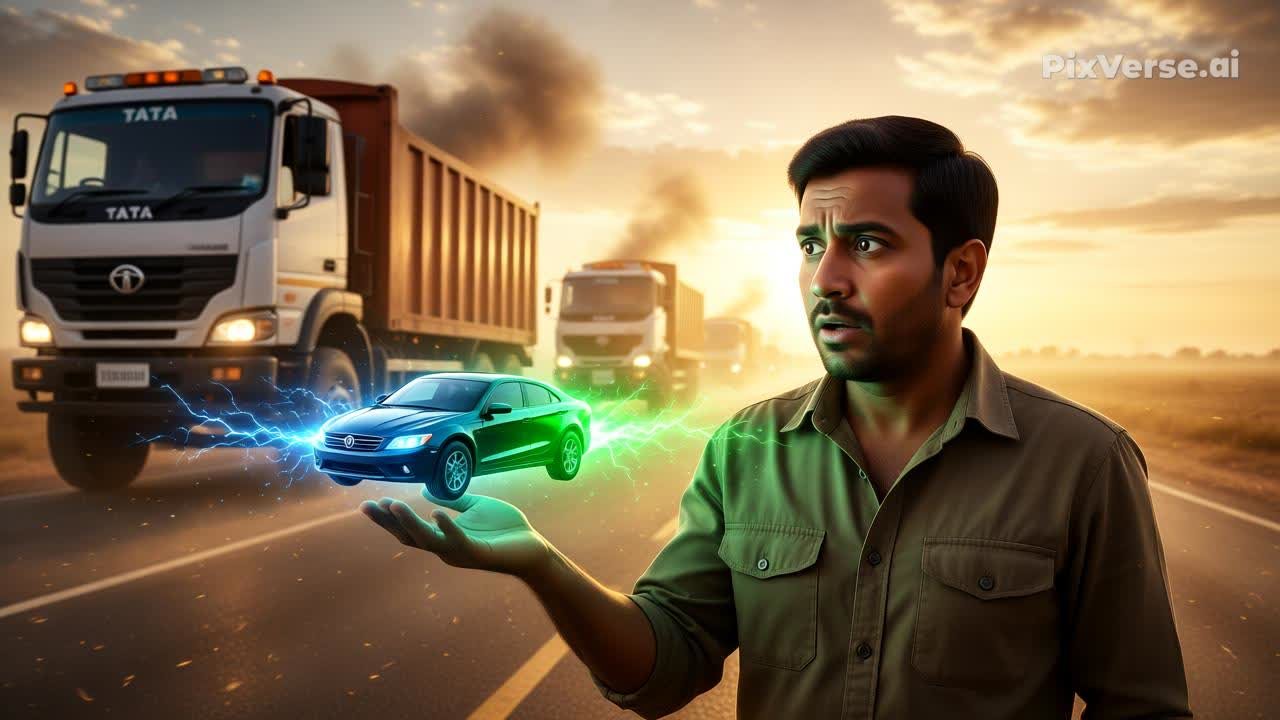
Let’s talk about Rajesh.
Rajesh isn’t a CEO. He’s not a politician. He’s a logistics manager at a medium-sized depot in Jaipur, and he is stressed.
His desk is a sea of spreadsheets, driver logs, and fuel receipts. Every morning, he wakes up, checks the price of diesel, and his stomach sinks. It’s not just the cost; it’s the volatility. How can you promise a client a 6-month freight rate when your biggest expense changes daily?
But that’s just the start of his migraine.
His clients, big e-commerce and FMCG companies, are suddenly sending him “Sustainability Scorecard” emails. They’re demanding “green logistics” and “carbon-neutral transport.” They want him to be eco-friendly, but they don’t want to pay a paisa more for it.
To top it all off, his 7-year-old diesel trucks are facing new restrictions. He can’t run them in Delhi-NCR during certain months. He’s heard whispers of a 10-year “scrappage” policy becoming mandatory nationwide.
Rajesh is trapped. His diesel fleet, once the backbone of his business, has become a ticking time bomb of unpredictable costs and regulatory nightmares.
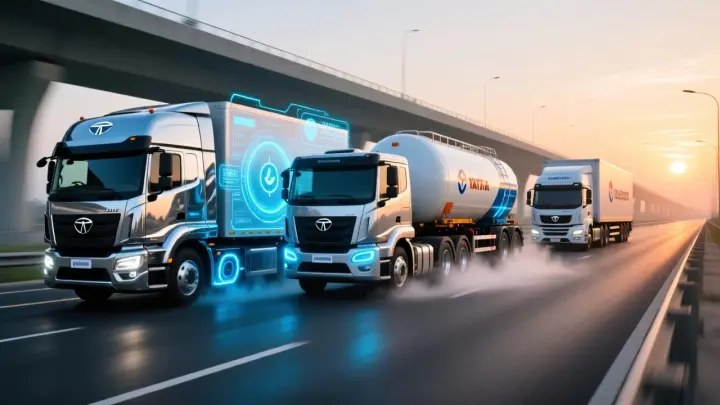
Then, during a late-night doom-scroll, he sees an article. It has a picture of a massive, 55-tonne Tata Prima truck. It looks like any other truck on the highway, but it’s silent. And the only thing coming out of its tailpipe is… water.
He reads about the Tata Prima H.55S Hydrogen truck. In another tab, he reads about the Tata Prima E.55S electric truck already being delivered to a logistics firm in his home state of Rajasthan.
He stops seeing a “green” fantasy. He starts seeing a business plan.
This isn’t just about saving the planet. This is about saving his company.
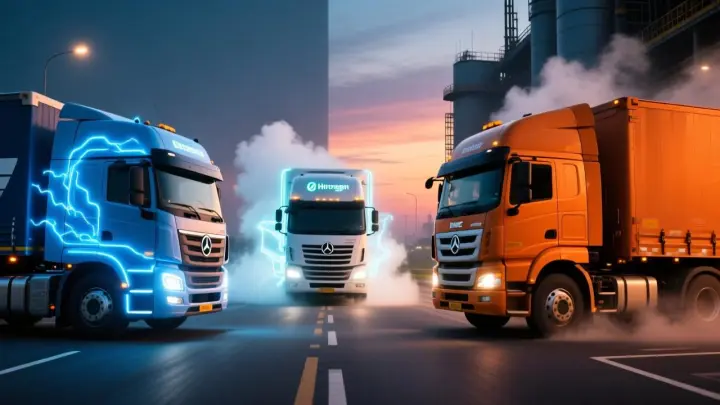
Rajesh’s story isn’t unique. It’s the story of every fleet owner, logistics manager, and truck operator in India. The diesel era is ending. And the future isn’t one-size-fits-all. It’s a two-pronged revolution, and Tata Motors is, quite literally, building both roads.
This is the deep dive into the future of Tata’s electric trucks and hydrogen trucks. One is your solution for today. The other is your key to tomorrow. And understanding the difference will be the single most important decision your logistics business makes in the next decade.
The Ticking Clock: Why Diesel is a Dying King
For 50 years, the diesel engine has been the undisputed king of Indian commerce. It’s been the sound of progress, the smell of industry.
Now, it’s a liability.
If you’re in the transport business, you already know this. You feel it every day.
- The Fuel Price Nightmare: Diesel prices are a rollercoaster, and you’re strapped in. This volatility makes Total Cost of Ownership (TCO) impossible to predict, turning your profit margins into a guessing game.
- The Regulatory Squeeze: The days of “run it ’til it dies” are over. From BS6 norms to the 10-year diesel ban in the NCR, the walls are closing in. Your most valuable assets could become worthless metal, by law.
- The Client Mandate: This is the new one, and it’s the most powerful. Your clients (Amazon, Flipkart, Unilever, Tata Steel) have their own net-zero goals. They cannot meet them if their supply chain (that’s you) is pumping out diesel fumes. They’re not asking for green logistics anymore; they’re demanding it.
- The Driver Deficit: Drivers are getting harder to find. They’re tired of the noise, the harsh vibrations, and the complex manual gearboxes. A tired driver is an unsafe and inefficient driver.
The problem is clear. Your business is being squeezed from all sides. Sticking with a 100% diesel fleet is no longer a strategy. It’s a gamble.
The Two-Lane Highway to the Future: EV vs. Hydrogen
So, what’s the solution? This is where it gets confusing. You hear “EV,” “Hydrogen,” “Fuel Cell,” “H2-ICE”… it’s an alphabet soup of new tech.
Tata’s genius is that they’re not forcing you to pick just one. They are pursuing a “dual-fuel” strategy.
Think of it like this:
- Battery Electric (BEV) is a Sprinter. It’s incredibly powerful, fast, and efficient over short distances. It’s perfect for city routes.
- Hydrogen (FCEV) is a Marathon Runner. It’s built for the long haul. It has incredible endurance and can refuel in minutes, not hours.
You wouldn’t use a marathon runner for a 100-meter dash, and you wouldn’t ask a sprinter to run 500 km.
Tata’s strategy is to give you the right tool for the right job. Let’s break down the toolkit.
Part 1: The Electric Revolution (The “Here and Now”)
Battery Electric Vehicles (BEVs) are not a 2030-hypothetical. They are on the road, delivering packages and cargo in India today.
This is your solution for last-mile, urban, and regional logistics. This is the “hub-and-spoke” model perfected.
The King of the Last-Mile: The Tata Ace EV
We all know the “Chota Hathi.” The Tata Ace revolutionized last-mile logistics. And now, the Tata Ace EV is doing it again.
For a small business owner, an e-commerce delivery partner, or a city-based distributor, this is a no-brainer.
- Payload: 600 kg (with the new Ace Pro EV pushing it to 750 kg)
- Range: A real-world 150+ km on a single charge.
- The Magic: A study on the Delhi-Jaipur corridor showed that electric trucks can achieve 20-26% lower energy costs than diesel. The maintenance is a fraction of the cost—no engine oil, no filters, no complex engine.
For a driver, it’s a dream: it’s silent, has no vibrations, and is automatic (less fatigue, more safety). For an owner, the TCO is dramatically lower.
The Middle-Mile Champions: The Tata Ultra E-Series
This is where it gets serious for fleet managers like Rajesh. What about moving goods from the warehouse on the city outskirts to the inner-city hubs?
Meet the Tata Ultra E.12.
- Target: E-commerce and urban logistics.
- Range: A flexible 120km to 350km, depending on the battery pack you choose.
- Payload: A serious 6.4 tonnes.
This is the perfect “hub-and-spoke” truck. It runs its route all day, comes back to the depot at night, and plugs in. It charges overnight when electricity is cheapest. It’s predictable, reliable, and cheap to run.
The Heavy-Duty Shocker: The Tata Prima E.55S
This is the one that changes the game. A 55-tonne Gross Vehicle Weight (GVW) electric truck.
“But wait,” you say, “electric is just for small trucks, right?”
Wrong.
Tata is already delivering the Prima E.55S to clients. A logistics firm in Rajasthan is using them right now for green transport in the cement and mining sectors.
- Range: 200-350 km.
- Power: A massive 470 kW.
- Use Case: This is for short-haul heavy-duty. Think: moving containers from a port to a nearby yard. Transporting clinker from a mine to a cement plant. Running between two major city depots.
The Electric Elephant in the Room: “But Where Do I Charge It?”
This is the #1 objection. And it’s a valid one.
Tata’s answer is what they call the “UniVerse”—a complete ecosystem.
- Tata Power: They aren’t just waiting for someone else to build chargers. Tata Power is actively installing high-capacity chargers along major corridors and at client depots.
- Depot Charging: The primary model for commercial EVs isn’t “finding a charger” like a car. It’s depot charging. Your fleet (like the Ultra E.12) finishes its route and charges overnight at your location. You have 100% control.
- Real-World TCO: Studies are proving the model. TCO parity (the point where an EV is cheaper than diesel) is already here. A recent report found that for a 12-ton truck, the payback period is just 3.1 years, with an 18% lower TCO over its life.
The EV Verdict: If your trucks run predictable, sub-300km routes and return to a central depot at night, a Tata electric truck is not just a “green” option; it’s the most profitable one.
Part 2: The Hydrogen Highway (The “Next Frontier”)
This is where Rajesh’s mind was blown. Electric is great for the city, but his real business is long-haul. His trucks run 24/7, from Jaipur to Mumbai. He can’t afford to stop for an 8-hour recharge.
This is the physics problem.
To get a 600km range on a 55-tonne electric truck, the battery would be so enormous and heavy, you’d be spending most of your energy… moving the battery. It’s a non-starter.
This is where hydrogen comes in.
A Hydrogen Fuel Cell (FCEV) truck is an electric truck. It has the same silent, powerful electric motors. But instead of a giant battery, it has a “portable power plant” on board.
How it works (the simple version):
- You pump Hydrogen (H2) gas into tanks (like CNG).
- The hydrogen gas goes into a Fuel Cell.
- The fuel cell mixes the hydrogen with Oxygen (O2) from the air.
- A chemical reaction creates Electricity (to power the truck) and Water (H2O).
That’s it. The only “emission” is pure, drinkable water.
The Benefits That Will End Diesel’s Reign
For a long-haul fleet, hydrogen solves all of diesel’s problems without any of the EV’s downsides.
- Long Range: The Tata Prima H.55S (a 55-tonne monster) boasts a range of 350-500 km on a single fill.
- Fast Refueling: This is the killer app. Recharging a giant EV battery takes hours. Refueling a hydrogen truck takes 10-15 minutes. Just like diesel.
- No Downtime: Your trucks can run 24/7, just like they do now. You don’t lose money while your asset is plugged into a wall.
- Heavy Payloads: Hydrogen tanks are far lighter than a 500km-range battery, meaning you can carry more cargo and less “fuel.”
Tata’s Dual-Hydrogen Strategy (This is the clever part)
Tata is attacking the hydrogen problem from two angles.
- FCEV (Fuel Cell): This is the ultimate goal. The Prima H.55S is a fuel cell truck. It’s the most efficient, “purest” form of hydrogen power.
- H2-ICE (Hydrogen Internal Combustion Engine): This is the bridge. Tata is also building trucks like the Prima H.28 that use a traditional diesel engine, but it’s been modified to burn hydrogen instead of diesel. It’s a “hydrogen-burning” truck.
This H2-ICE approach is brilliant. It’s cheaper to build (it’s a modified diesel engine) and gets the market used to handling and storing hydrogen, all while the more expensive fuel cell tech gets cheaper.
The Hydrogen Hurdle: “But Where Do I Get the Gas?”
This is the exact same question people asked about EV chargers. And the answer is the same: Tata is building the ecosystem.
They know you can’t sell a truck with no fuel. So, in 2025, they launched a massive, 24-month trial with 16 hydrogen-powered trucks.
- Key Partners: They are working with the Government (National Green Hydrogen Mission) and fuel giants like IOCL (Indian Oil).
- Key Routes: They are testing these trucks on the busiest freight corridors in India, including Mumbai-Pune, Delhi-NCR, and Jamshedpur.
Tata isn’t just waiting for a hydrogen network to appear. They are creating the business case, running the numbers, and building the “hydrogen highway” themselves, one truck at a time.
The Fleet Manager’s Cheat Sheet: EV or Hydrogen?
Still confused? Here’s the simple breakdown for Rajesh (and you).
✅ You should invest in a TATA ELECTRIC TRUCK (like the Ace EV or Ultra E.12) if:
- Your trucks run predictable routes under 300km per day.
- You operate mostly inside cities (last-mile, urban delivery, e-commerce).
- Your trucks return to a central depot every night where they can be charged.
- Your #1 priority is the absolute lowest possible running cost (TCO).
🟡 You should be planning for a TATA HYDROGEN TRUCK (like the Prima H.55S) if:
- Your trucks run long-haul, inter-state routes (500km+).
- You carry heavy-duty, time-sensitive payloads (steel, cement, containers).
- You cannot afford downtime; your trucks must refuel in minutes, not hours.
- Your #1 priority is maximum uptime and replacing your diesel fleet 1-for-1.
The TCO Revolution: Why “Greener” is Finally “Cheaper”
Let’s go back to Rajesh’s spreadsheets. This entire revolution—all this new tech—is pointless if it doesn’t make financial sense.
For decades, “green” meant “more expensive.” That era is over.
The Total Cost of Ownership (TCO) model is flipping.
- Diesel TCO: Low Upfront Cost | High, Volatile Running Cost (Fuel) | High Maintenance Cost.
- Electric TCO: High Upfront Cost | Dramatically Low Running Cost (Electricity) | Extremely Low Maintenance Cost.
- Hydrogen TCO: High Upfront Cost (for now) | Stable, Predictable Running Cost | Low Maintenance Cost.
The math is already proving it. For a 12-ton electric truck, the 18% lower TCO saves you Rs. 72 lakh over its 15-year life. The 3.1-year payback means that for the next 12 years, that truck is a pure profit-generating machine.
The government is accelerating this with FAME incentives and PLI schemes, making the upfront cost easier to swallow.
You are no longer just buying a truck. You are making a long-term financial investment. You’re shifting your biggest expense (diesel fuel) into an asset (an electric or hydrogen truck) that insulates you from price shocks and regulatory nightmares.
Conclusion: Don’t Get Left in the Diesel Dust
The shift from diesel is no longer a question of “if,” but “when.”
For fleet managers like Rajesh, the future is finally clear. The anxiety of unpredictable fuel costs and regulatory bans is being replaced by a set of clear, strategic choices.
This isn’t sci-fi. This is smart business.
The Tata Ace EV is already dominating last-mile. The Tata Prima E.55S is already being delivered to heavy-duty logistics firms. The Tata Prima H.55S is already running trial routes on our nation’s highways.
The choice is simple. You can be the fleet manager who holds onto their diesel trucks until they are regulated off the road, or you can be the one who makes the smart switch, slashes your operating costs, and wins clients by offering the green logistics solutions they are begging for.
The future of Indian trucking will be silent, clean, and—for the first time—predictable. And it will be built by Tata.
Is Your Fleet Ready for the Future? Or Stuck in the Past?
Don’t let unpredictable diesel costs and new regulations put your business at risk. The “wait and see” approach is no longer an option.
Your competitors are already calculating their TCO savings with EV and Hydrogen. It’s time you did, too.
Contact our team of logistics specialists today for a Free, No-Obligation TCO Analysis. We’ll use your own fleet data—your routes, your fuel costs, your payloads—to build a clear, actionable report showing you exactly how much you could save by integrating Tata’s electric and hydrogen solutions.
Stop guessing. Start planning.