Advertisement
Let’s talk about Rajesh.
Rajesh runs a mid-sized logistics company in Pune. He has a fleet of 15 “Chhota Haathi” (Tata Ace) trucks that he’s run for 12 years. These trucks, sputtering diesel and rattling with effort, are the lifeblood of his business, moving everything from medical supplies to e-commerce packages across the city.
But Rajesh has a massive, wallet-burning problem.
His fuel bill. It’s a monster. Every month, he watches the price of diesel creep up, and it eats directly into his profits. His drivers complain about the noise. His maintenance costs for aging diesel engines are spiraling. He feels stuck, running faster and faster just to stay in the same place.
One Tuesday, while stuck in traffic, a new truck pulls up beside him. It’s a Tata Ace EV. It’s silent. It’s clean. It has a big Amazon “Prime” logo on the side. It zips past him in the next lane, and Rajesh has a sinking feeling.
He’s not just looking at a new truck. He’s looking at the future. And he’s worried he’s being left behind.
“It’s a toy,” he mumbles to himself. “What’s the range? Where does it even charge? It’ll never work for my business.”
But is he right?
This article is for Rajesh. It’s for every fleet owner, logistics manager, and small business owner in India who is staring at a diesel bill with a mix of dread and frustration.
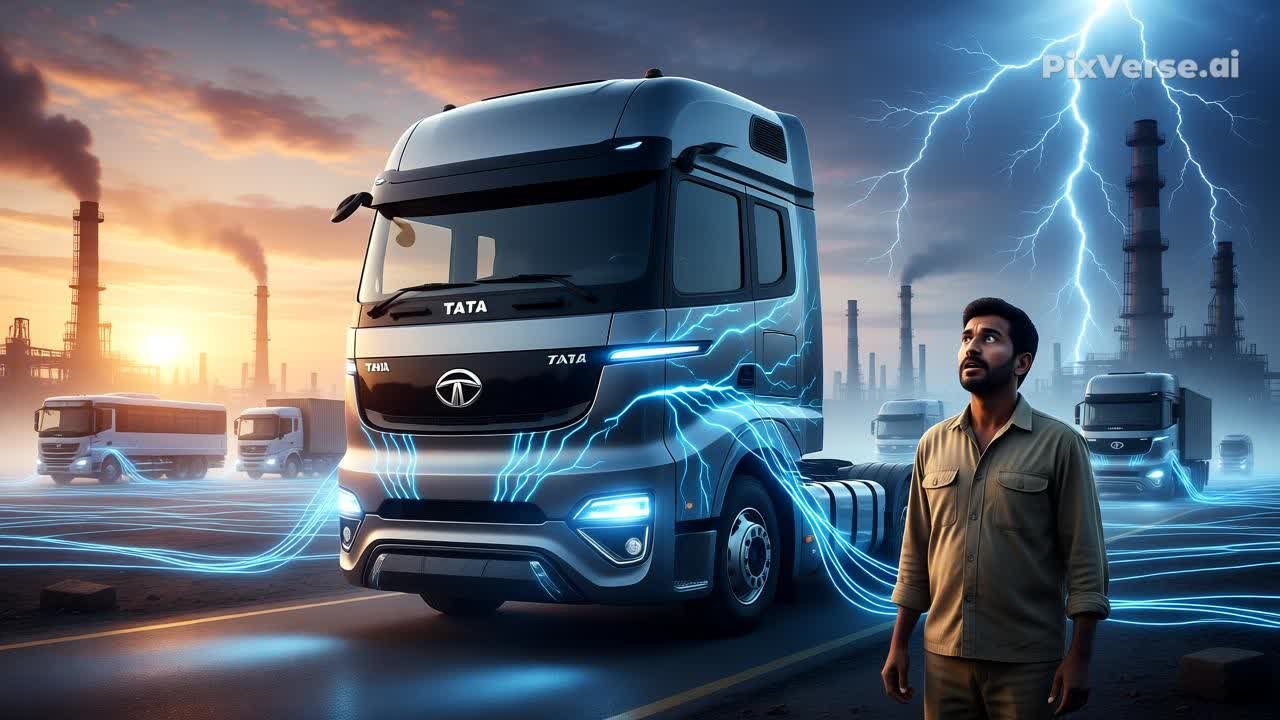
Because what’s happening in India’s electric commercial vehicle (eCV) market isn’t a slow-and-steady transition. It’s a revolution. And Tata isn’t just participating in it; they are the ones building the entire stadium, writing the rulebook, and selling all the tickets.
This is the deep-dive, no-fluff story of Tata’s role. It’s not just about building trucks. It’s about building an entire country’s trust in a new technology.
The Boiling Pot: Why India’s Commercial Sector Is Begging for EVs
You can’t just drop an electric truck into a market and expect it to work. The market has to be desperate for it. And India, in 2026, is desperate.
Think of the “old way” as a boiling pot of water.
- The Heat (Diesel Prices): Fuel costs are unpredictable and relentlessly high. For a logistics business where fuel is 40-50% of the cost, this is a five-alarm fire.
- The Steam (Pollution & Policy): India’s cities are choking. The government has to act. This leads to regulations, “green” taxes, and entry-restrictions for diesel vehicles in cities like Delhi.
- The Pressure (E-Commerce Boom): You, me, all of us. We’re ordering everything online. This has created a massive demand for “last-mile delivery”—the most expensive and polluting part of the supply chain.
Into this boiling pot, diesel is a problem. And Tata’s electric commercial vehicles are the first, best, and most complete answer.
This isn’t just theory. The numbers are staggering. The electric commercial vehicle segment saw a 105.9% year-over-year growth last month. It is the single fastest-growing part of the entire EV revolution.
And who’s leading it? As of October 2025, Tata Motors holds over 40% of the e-goods carrier market. This isn’t an accident. It’s a plan.
The “Tata Group” Advantage: Why This Is Bigger Than Just Tata Motors
Here is the single most important thing you need to understand.
When you compete with Tata in the eCV space, you’re not just competing with Tata Motors. You’re competing with a $300 billion-dollar ecosystem.
This is Tata’s “unfair advantage.”
- Need a truck? Tata Motors builds it (Ace EV, Ultra E.T, e-buses).
- Need to charge it? Tata Power is building the charging network.
- Need a loan for it? Tata Capital will finance your fleet.
- Need the battery? Tata AutoComp and Tata Chemicals are working on battery tech and recycling.
- Need the software? TCS helps build the advanced telematics.
Think of it like Apple. You can buy a great Android phone. But you can’t buy an Android phone that works perfectly with the Apple Watch, AirPods, iCloud, and the Mac.
Tata is building the “Apple Ecosystem” for India’s logistics. They aren’t just selling Rajesh a truck. They are offering to solve his entire business problem.
Pillar 1: The Last-Mile Tsunami — The Tata Ace EV
This is the hero. The one you see everywhere. The original “Chhota Haathi” (small elephant) has gone electric, and it’s taking over.
The Tata Ace EV is a masterclass in understanding the Indian market. It’s not designed to be a Tesla Cybertruck. It’s designed to do a very specific job, perfectly.
What Is It, Really?
It’s a 4-wheel, 600kg payload truck with a real-world range of around 154 km. This isn’t meant for highway runs from Delhi to Mumbai. It’s designed for the “hub-and-spoke” model.
Think of it: A big truck arrives at a warehouse on the edge of Bengaluru. A dozen Ace EVs load up and spend the entire day zipping through city traffic, delivering packages, and returning to the warehouse at night to recharge.
For that job, 154 km is more than enough.
The TCO Revolution (Total Cost of Ownership)
This is the “aha!” moment for fleet owners like Rajesh. We’re conditioned to look at the sticker price. And yes, the Tata Ace EV (at approx. ₹9.21 Lakh) costs more upfront than its diesel cousin.
But the sticker price is a lie. It’s the running cost that matters.
Let’s do some simple, back-of-the-napkin math.
| Feature | Diesel Tata Ace | Tata Ace EV |
| Fuel/Energy Cost | ~₹5-6 per km | ~₹0.8 – ₹1.0 per km |
| Maintenance | High (Engine oil, filters, coolant, complex engine) | Extremely Low (No engine, no oil, fewer moving parts) |
| Vehicle Uptime | Good, but downtime for engine service is real. | Higher (Less maintenance = more days on the road) |
| Savings | – | Claims up to 25% higher savings over diesel. |
For a truck running 100-120 km a day, the fuel savings alone can be over ₹500 per day, per truck.
Now, multiply that by Rajesh’s 15-truck fleet.₹500 x 15 trucks x 30 days = ₹2,25,000. Per month.
This isn’t a “toy” anymore. This is a profit-generating machine. This is why Amazon, Flipkart, BigBasket, and Delhivery have placed orders for tens of thousands of them. They did the math.
Pillar 2: Moving Up — The “Middle & Heavy” Electric Haul
The Ace EV is perfect for the last mile. But what about the “middle mile”? Moving goods from a factory to a city’s distribution hub?
This is where the Tata Ultra E.T series comes in. These are the real trucks.
- Tata Ultra T.7 EV: A 4.9-tonne payload monster. This is the truck you use for FMCG distribution, waste management (like the “Swachh Bharat” city trucks), and heavy-duty logistics inside a city.
- Tata Ultra E.12: A bigger, more powerful version for even heavier loads.
The Hydrogen Horizon (Tata’s Long Game)
This is what separates a leader from a follower. Tata knows that for long-haul, 500+ km trucking, today’s batteries aren’t the answer. The charging time is too long, and the batteries are too heavy.
So, what’s their answer? Hydrogen.
Tata has already showcased the Prima H.55S, India’s first hydrogen-powered truck. This isn’t a PowerPoint slide; it’s a real, working vehicle.
This is Tata’s “role”:
- Today (Last-Mile): Dominate with the Battery Electric (BEV) Ace EV.
- Tomorrow (Medium-Mile): Dominate with the BEV Ultra E.T series.
- Future (Long-Haul): Dominate with Hydrogen Fuel Cell (HFCV) trucks.
They are playing 3D chess while competitors are playing checkers.
Pillar 3: Moving the Masses — The Electric Bus Domination
Tata’s role isn’t just about moving parcels; it’s about moving people. If you’ve taken a new, quiet, air-conditioned public bus in Delhi, Bengaluru, or Jammu, there’s a good chance you were on a Tata.
This is a huge part of India’s e-mobility solutions.
Not a Sale, a Partnership
Tata didn’t just sell 921 electric buses to the Bengaluru Metropolitan Transport Corporation (BMTC) and walk away. That’s the old model.
Instead, they operate on a “Gross Cost Contract” (GCC) model.
- BMTC (the city) pays Tata a fixed rate per kilometer.
- Tata provides the buses, manages the drivers, pays for the electricity, and is responsible for all maintenance and uptime.
This is brilliant. The city gets a state-of-the-art, zero-pollution bus fleet with zero headache. Tata gets a predictable, 10-12 year contract and builds a massive charging and service infrastructure to support it.
This model is so successful that Tata has nearly 3,700 e-buses on Indian roads, which have already clocked over 400 million kilometers. They are the undisputed leader in this space, with competitors like Olectra Greentech and JBM Auto fighting for the next spot.
The “But… What About?” Section: Tata’s Ecosystem Answer
Let’s go back to Rajesh, our skeptical fleet owner. His first objections were “What’s the range?” and “Where do I charge?”
This is where Tata’s ecosystem play becomes their knockout punch.
Objection 1: “Where do I charge?” (The Range Anxiety)
This is the #1 fear. And it’s a valid one.
Tata’s Answer: “Everywhere.”
- Tata Power: The group’s power company, is on a mission. As of late 2025, Tata Motors has made 25,000 public charging points accessible for its commercial vehicle customers.
- The Next 25k: They’ve already signed MoUs with 13 other charging operators to add another 25,000 chargers in the next 12 months.
- Home-Base Charging: They will come to Rajesh’s depot and install the exact number of slow/fast chargers he needs for his fleet.
They are solving the chicken-and-egg problem. You can’t sell e-trucks without chargers. So, they’re building the chargers.
Objection 2: “What if it breaks down? My local mechanic can’t fix this.”
A diesel Ace is simple. Any mechanic on any highway can fix it. An electric truck is a computer on wheels.
Tata’s Answer: “Sampoorna Seva 2.0” (Complete Service 2.0).
This is Tata’s comprehensive after-sales package, now rebuilt for EVs.
- Warranty: Multi-year, high-kilometer warranties on the battery and drivetrain.
- Tata Alert: 24/7 roadside assistance.
- Dedicated EV Support: Tata is establishing over 200 dedicated EV support centers and training its mechanics to become EV specialists.
Objection 3: “It’s too expensive! I can’t get a loan for a ‘toy’.”
This is the final barrier. The sticker price.
Tata’s Answer: “We’ll handle the money, too.”
- Tata Capital: The group’s financial arm. They understand the TCO math. They can create customized financing solutions for fleet owners that traditional banks might reject.
- Government Subsidies: Tata’s team helps fleet owners navigate and claim all available government incentives, like the new PM E-DRIVE scheme (which replaced FAME-II) and state-level road tax exemptions.
They de-risk the entire purchase.
The Big Picture: Tata’s Role Isn’t “Seller,” It’s “Architect”
By 2030, India’s logistics market will be unrecognizable. The roar of diesel engines will be replaced by the quiet hum of electric motors.
The company that wins won’t be the one that just sells the cheapest truck. It will be the one that provides the most reliable and complete solution.
This is Tata’s role in India’s electric commercial vehicle market.
- They are the Leader, with over 40% market share.
- They are the Pioneer, with a product for every segment (Ace, Ultra, E-Bus).
- They are the Innovator, looking ahead to hydrogen.
- And most importantly, they are the Architect, building the entire ecosystem of charging, finance, and service that makes the whole revolution possible.
Their competitors are strong. Mahindra is a giant in its own right with the Jeeto. Ashok Leyland, Eicher, Olectra, and Euler Motors are all fighting hard.
But they are all playing on a field that Tata built.
For Rajesh, the skeptical fleet owner, the choice is becoming clear. Sticking with diesel is no longer the “safe” bet; it’s the risky one. The silent, green truck that just zipped past him wasn’t a threat. It was an invitation.
Your Turn: Stop Guessing, Start Calculating
Are you a fleet owner? A logistics manager? A small business owner? You can’t afford to ignore this.
The “diesel vs. electric” debate is over. The only question left is when you will make the switch, not if.
But you don’t need a 4,000-word article; you need a hard number. You need to know your Total Cost of Ownership (TCO).
We can help.
Stop wondering what you could be saving. Let’s find out. Click the link below to schedule a free, no-obligation e-fleet consultation. We’ll help you analyze your current diesel costs and build a customized TCO report to show you exactly how much you could save by adding Tata’s electric commercial vehicles to your fleet.