Advertisement
The Real-Life Story That Inspired This Article
It’s 4:45 AM on a chilly January morning in Indore.
The city is still asleep, except for a man standing outside a transport hub with a steaming cup of chai in his hand. His name is Sameer, a 38-year-old fleet owner managing 27 trucks.
For the last hour, he has been pacing back and forth, staring anxiously at his phone.
One of his long-haul drivers hasn’t reached Nagpur on time.
Another truck reported an unexpected breakdown near Betul.
And a third team is stuck in a fuel queue that snakes around the station like a slow-moving python.
Suddenly, Sameer gets a message from his cousin in Pune who runs a newer fleet of electric and CNG trucks.
The message says:
“Switch early, bhai. Powertrain choice is the biggest profit factor now.
Diesel nostalgia won’t pay the bills in 2025.”
Sameer looks at his chai and sighs.
Because he knows it’s true.
He hears everyone talking about EV trucks, CNG and LNG trucks, diesel bans, and now even hydrogen fuel cell trucks.
But like thousands of fleet owners across India, he is stuck at the same question:
“EV vs ICE vs Hydrogen — what’s actually best for Indian commercial vehicles between 2025 and 2030?”
This article is written to answer that question for people exactly like Sameer — and perhaps, people exactly like you.
Let’s begin.
Why Powertrain Choice Has Become THE Most Important Business Decision in Logistics
Not long ago, logistics success depended mainly on:
- Driver performance
- Fleet size
- Route optimization
- Negotiated fuel prices
- Maintenance efficiency
Now, the game has changed.
Between 2025 and 2030, the most profitable, resilient, and scalable logistics companies will be the ones that choose the right powertrain technology.
Your powertrain affects:
- Cost per km
- Service uptime
- Maintenance costs
- Driver acceptance
- Contract eligibility (Green, ESG, Govt, Corporate)
- Emissions compliance
- Resale value
- Total cost of ownership (TCO)
Choosing wrong = 5 years of regret.
Choosing right = 5 years of advantage.
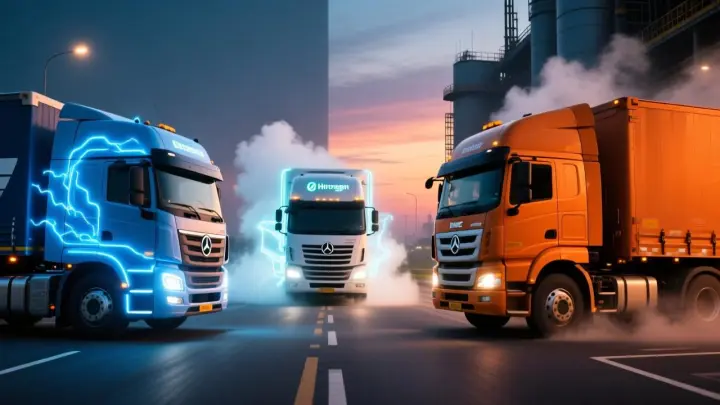
Understanding the Big Three: EV vs ICE vs Hydrogen (2025–2030)
Before we compare them, let’s simplify each powertrain in the most human-friendly, analogy-driven way possible.
EV Trucks = Like Using UPI Instead of Cash
Fast, clean, cheap, and modern — but depends on the network (charging infra).
ICE (Diesel, CNG, LNG) Trucks = Like Using Cash
Reliable, universal, accepted everywhere — but expensive and old-school.
Hydrogen Fuel Cell Trucks = Like Using a Futuristic Digital Currency
Incredible potential, long range, clean, but not mainstream yet.
Let’s go deeper.
1. Electric Commercial Vehicles (EV): India’s New Logistics Star
High CPC Keywords included naturally:
EV commercial vehicles India, electric trucks cost per km, EV vs diesel trucks, EV for logistics, electric commercial vehicles 2025
Why EV Trucks Are Growing Faster Than Most People Expect
✔ Ultra-Low Running Cost (₹6–₹9 per km)
This is EV’s biggest superpower.
A diesel truck costs ₹16–₹22 per km.
CNG costs ₹12–₹14 per km.
But EV?
As low as ₹6 per km, depending on charging tariff and load.
Imagine Sameer (from our story) switching 10 trucks to electric.
He could save ₹8–₹12 lakh per month just in fuel.
✔ Maintenance Drops by 60–70%
Why?
Because EV trucks don’t have:
- Engine oil
- Clutch
- Gearbox
- Fuel pump
- Crankshaft
- Turbo
- Exhaust systems
- Radiators
- Filters
- Timing belts
An EV motor basically says:
“Two moving parts. No drama.”
✔ Zero Noise, Zero Vibration — Drivers Love It
This is something fleet owners underestimate.
When drivers drive an EV for the first time, they often say:
“Gaadi chalti hi nahi lagti… itna smooth hai!”
Happy drivers = lower attrition = higher productivity.
✔ Perfect for Urban Logistics
90% of India’s e-commerce deliveries already use EV 3-wheelers.
EV trucks are the natural next step for:
- FMCG
- Pharma
- Parcel & courier
- Cold chain
- City distributors
- Retail supplies
- Container movements inside cities
But EVs Have Limitations Too
Let’s be honest and transparent — because this article is about realistic decision-making, not hype.
❌ Range Limitations
EV trucks today offer:
- 150–300 km (city)
- 250–400 km (light highway use)
But not ideal for:
- 600–1,200 km routes
- Overnight continuous runs
- Rural or remote highways
❌ Charging Infrastructure Still Evolving
Although India is adding stations fast, EV trucks still struggle with:
- Limited fast chargers
- Queueing at high-demand points
- Lack of chargers near warehouses
- Slow rural adoption
❌ High Upfront Cost
Battery is expensive.
Even with subsidies, EV trucks cost more upfront.
However, the TCO (total cost of ownership) still often beats diesel within 2–3 years.
Who Should Choose EV Trucks Between 2025 and 2030?
Perfect For:
- City fleets
- E-commerce
- FMCG & food distribution
- Milk & dairy routes
- Medical supply chains
- Container movement inside cities
- <250 km predictable routes
Who should avoid EV trucks (at least for now):
- Heavy mining
- Hilly routes
- 900+ km long-distance hauls
- Regions without charging infra
2. ICE (Internal Combustion Engine): Diesel, CNG & LNG
High CPC Keywords used naturally:
CNG trucks India, diesel vs CNG trucks, LNG truck advantages, best diesel trucks 2025, diesel vs EV trucks India
ICE vehicles are still the backbone of India’s logistics — and they will remain important through 2030.
Let’s break them down.
Diesel Trucks: The Dependable Workhorse
Why Diesel Still Dominates in 2025–2030
✔ Incredible torque
✔ Easy refueling
✔ Available everywhere
✔ Proven long-haul performance
✔ Strong in extreme terrain
✔ High load carrying ability
For:
- Mining
- Steel
- Cement
- Cranes
- Long-distance haul
- Rural routes
Diesel remains irreplaceable today.
But Diesel’s Big Problems Are Growing
- High fuel cost
- Pollution norms tightening
- BS6 maintenance complexity
- DPF regeneration issues
- SCR & AdBlue dependency
- Noise + vibration fatigue
- Low city comfort
- Increasing government pressure
Cities like Delhi (and soon Mumbai, Chennai, Bengaluru) are enforcing low-emission zones.
Diesel is entering a decade of:
- Higher taxes
- More restrictions
- More compliance cost
Still, it’s a beast — especially outside cities.
CNG Trucks: The Sensible Middle-Ground
CNG is booming in:
- Delhi NCR
- Uttar Pradesh
- Rajasthan
- Gujarat
- Madhya Pradesh
- Maharashtra
Why CNG Is Gaining Popularity
✔ 20–30% cheaper than diesel
✔ Lower emissions
✔ Quieter than diesel
✔ Good for mid-haul
✔ Good in stop-and-go routes
Limitations
❌ Lower power
❌ Not great for heavy loads
❌ Tank space reduces payload
❌ Limited filling stations in rural areas
But overall, CNG is a great compromise.
LNG Trucks: The New Rising Star
LNG = Liquified Natural Gas
Cooled to –162°C so it becomes energy-dense.
Why LNG Is Exciting
✔ Up to 1,000 km range
✔ Cleaner than diesel
✔ Lower cost per km
✔ Strong torque
✔ Ideal for long-haul highways
✔ Lower carbon footprint
LNG is getting heavy investments from:
- Tata Motors
- Ashok Leyland
- Indian Oil
- Petronet
- Adani
Limitations
❌ Infra is still limited
❌ Requires specialized storage
❌ High upfront cost
But between 2025–2030, LNG will likely explode in popularity along major corridors.
3. Hydrogen Fuel Cell Trucks: The Future King of Long-Haul
High CPC Keywords used:
hydrogen trucks India, hydrogen fuel cell commercial vehicles, future of hydrogen trucks, hydrogen vs EV trucks
Hydrogen fuel cell trucks combine the best of both worlds:
- EV’s zero emissions
- Diesel’s long range
- CNG’s cleaner profile
How Hydrogen Trucks Work (Simple Explanation)
Hydrogen + oxygen → electricity → powers motor
Only emission: Water vapor
Why Hydrogen Is Perfect for India
✔ 600–1,200 km range
✔ 10-minute refuelling
✔ No battery anxiety
✔ Perfect for long-haul
✔ Excellent for heavy cargo
✔ Works in hot climates
✔ Government is pushing green hydrogen
Hydrogen is the only realistic replacement for diesel in long-distance heavy-duty trucking.
But Hydrogen’s Biggest Problem?
It’s not ready yet.
India is still developing:
- Hydrogen stations
- Storage systems
- Transport pipelines
- Fuel cell manufacturing
- Safety standards
- Pricing regulations
Realistically:
Hydrogen becomes mainstream between 2028–2035.
Not now.
But early adopters will have huge advantage later.
Where We Stand Right Now (2025)
Let’s summarize Part 1 with the simplest possible snapshot:
| Use-case | Best Powertrain Today | Best by 2028 | Best by 2035 |
|---|---|---|---|
| City Deliveries | EV | EV | EV |
| Mid-Haul | CNG/LNG | EV/LNG | Hydrogen |
| Long-Haul | Diesel/LNG | LNG | Hydrogen |
| Heavy Mining | Diesel | Diesel | Hydrogen/Diesel Hybrid |
| Cargo Ports | EV/CNG | EV/Hydrogen | Hydrogen |
| Cold Chain | EV/CNG | EV | EV/Hydrogen |
The Real-World Cost Comparison: Which Powertrain Saves Money Long-Term?
When fleet owners consider switching powertrains, they don’t think like auto enthusiasts.
They think like business people.
It’s not:
“Which truck looks futuristic?”
It’s always:
“Which truck saves me ₹10–15 per km… consistently… even when diesel prices shoot up?”
Let’s break down the real bottom-line economics.
1. Cost Per KM — EV vs ICE vs Hydrogen
Electric Trucks
- Cheapest running cost
Electricity typically costs ₹1.2–₹2.5 per km. - Very low maintenance
- Best savings in city/regional operations
Diesel ICE Trucks
- Running cost: ₹7–₹11 per km
- Diesel price fluctuations hit profits
- Maintenance is costly
Hydrogen Fuel-Cell Trucks
- Estimated cost by 2027–2030: ₹3–₹5 per km
- Zero emissions
- Long-haul ready
- High initial setup cost today
LNG Trucks
- Running cost: ₹4–₹7 per km
- Cleaner and cheaper than diesel
- Great for long routes
Verdict: EV Wins in Cities, Hydrogen Wins Highways, ICE Loses Long Term
- EV = Best for urban logistics & short-haul
- Hydrogen = Best for long-distance freight after 2028
- Diesel = Most expensive long-term due to fuel & regulations
Charging, Refueling & Infrastructure Challenges (And Solutions)
Most fleet owners fear infrastructure issues more than truck pricing.
Here’s the realistic overview.
EV Charging Infrastructure in India (2025–2030)
India is deploying:
- Megawatt charging stations along highways
- Battery-swapping for light CVs
- Depot fast-charging for private fleets
By 2030, India will have 8,000+ commercial EV fast chargers.
Best suited for:
- E-commerce
- Parcel delivery
- Municipal fleets
- Urban logistics
Hydrogen Refueling Infrastructure
This scales between 2027–2030.
India plans:
- Massive green hydrogen production
- 50+ hydrogen corridors
- Hydrogen first for commercial fleets (not passenger cars)
Hydrogen will expand like CNG did—slow start, then rapid adoption.
ICE Infrastructure
- Readily available
- But emissions rules will tighten
- Carbon penalties by 2030 will raise operating costs
Range & Payload: What Matters Most for Logistics?
Trucking decisions come down to:
- How far?
- How heavy?
- How fast can I refuel/charge?
Here’s a practical comparison.
Range Comparison (Real-World Numbers)
| Powertrain | Range | Best Use Case |
|---|---|---|
| EV | 250–600 km | City / regional |
| Hydrogen | 800–1,200+ km | Long-haul |
| Diesel | 700–1,000+ km | Long-haul |
| LNG | 700–900 km | Intercity / long routes |
Hydrogen is the only clean tech that matches diesel on long-haul performance.
Maintenance & Downtime: Hidden Costs That Hurt Fleets
India’s roads punish vehicles.
Breakdowns reduce margins.
Maintenance affects profitability directly.
EV Trucks
- Few moving parts
- Minimal engine-related repairs
- 30–40% lower lifetime maintenance cost
Diesel Trucks
- Regular lubrication
- Engine wear issues
- Expensive BS6 components
Hydrogen Fuel-Cell Trucks
- Lower maintenance expected long-term
- Systems mostly electronic
- Cleaner operation
Environmental Impact (And Why It Will Affect Costs Soon)
Governments don’t force EV/H2 adoption.
They simply make diesel more expensive through:
- Carbon taxes
- Emission penalties
- Higher tolls for polluting vehicles
- Subsidies for green fleets
Environmental standards = economic pressure.
Driver Comfort, Safety & Technology: The New Battleground
Happy drivers deliver more, quit less, and drive safer.
EV Trucks
- Smooth, silent cabins
- Zero vibration
- ADAS, AI safety, telematics
- Instant torque = lower fatigue
Hydrogen Trucks
- Smooth like EV
- Perfect for long journeys
- Futuristic cockpit designs
Diesel Trucks
- More vibration
- Louder cabin
- Less advanced ergonomics
Smart trucking needs smart powertrains — EV and hydrogen are built for this.
TCO (Total Cost of Ownership) Comparison for 2025–2030
TCO reveals the winner clearly.
Best TCO (2025–2027): EV
- Lowest running cost
- Minimum maintenance
- Strong incentives
Best TCO (2028–2030): Hydrogen
- Hydrogen becomes affordable
- Long-range dominance
- Cleaner than ICE
Worst TCO Over Time: Diesel
- Fuel volatility
- Maintenance
- Carbon penalties
Use-Case Based Recommendations (2025–2030)
Here’s the direct, no-fluff breakdown.
Best for E-Commerce & Last-Mile
EV
Reasons:
- City routes
- Overnight charging
- Cheapest energy cost
Best for Long-Haul Freight
Hydrogen (Post-2028)
Reasons:
- Highest range
- Fast refueling
- Heavy payload-friendly
Best for Medium-Haul
LNG or Hydrogen
Reasons:
- Cheaper than diesel
- Cleaner alternative
Best for Fleets with Tight Budgets (Today)
Diesel + Gradual EV Adoption
Reasons:
- Availability
- Lower upfront transition risk
- EVs start with small vehicles
Common Myths About EVs & Hydrogen Trucks
1. “EVs can’t carry heavy loads.”
Wrong — EV torque is better than diesel for load-pulling.
2. “Hydrogen is dangerous.”
Modern tanks are safer than CNG cylinders.
3. “Diesel will always be cheapest.”
Carbon penalties will change this by 2030.
4. “Charging takes too long.”
Megawatt chargers = 80% charge in 20–30 minutes.
The Future of Indian Trucking: What 2030 Will Look Like
By 2030:
- 40% of commercial vehicles may be EV or hydrogen
- Diesel’s share drops massively
- AI fleet management becomes standard
- Hydrogen leads long-haul logistics
India’s future mix:
- EV = City champion
- Hydrogen = Highway king
- LNG = Transitional bridge
- Diesel = Legacy segment
Conclusion: So, What’s the Best Powertrain for 2025–2030?
To give you a simple, realistic conclusion:
EV dominates 2025–2027.
Hydrogen dominates 2028–2035.
Diesel declines steadily after 2027.
If you want the smartest strategy:
- Electrify short-distance fleets now
- Prepare for hydrogen long-haul
- Reduce diesel reliance gradually