Advertisement
A Fleet Owner’s Turning Point: The Story That Changed Everything
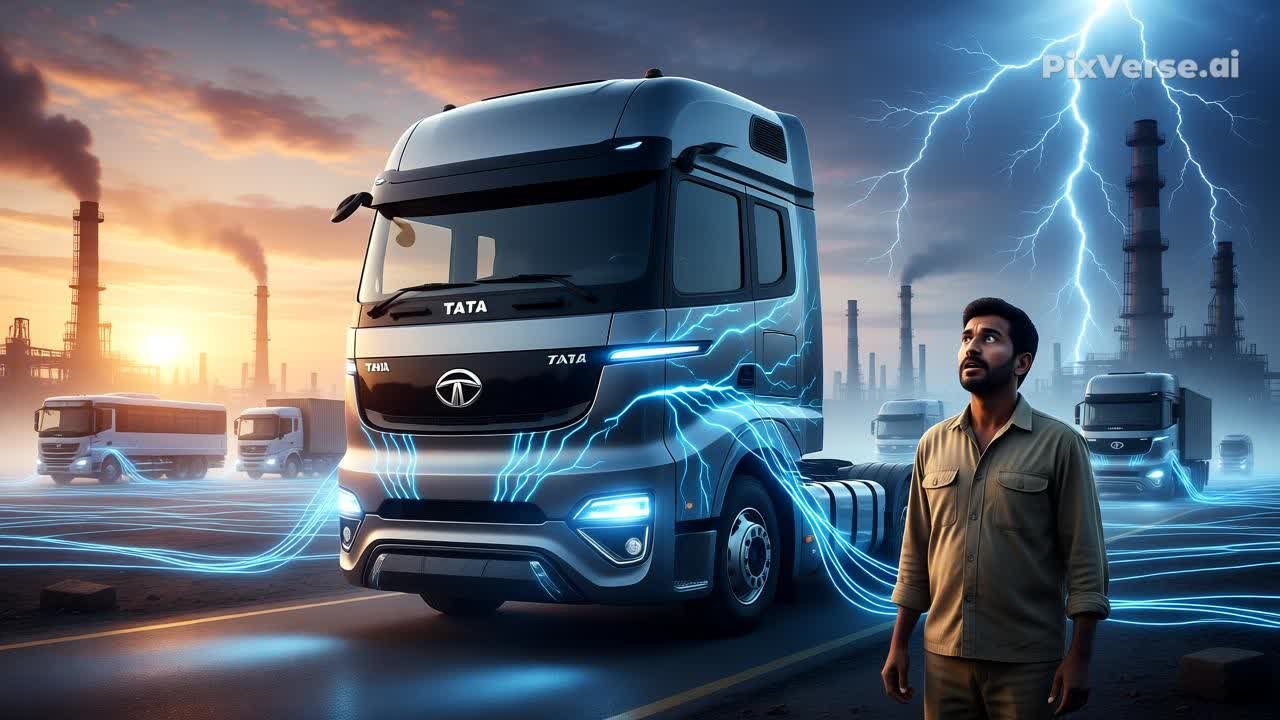
On a cold December morning in early 2025, Rajeev Malhotra—owner of Malhotra Logistics, a fleet of 47 trucks covering Maharashtra, Gujarat, and Madhya Pradesh—sat anxiously at his office desk. His accountant had just walked out after presenting numbers that felt like a punch to the chest.
Fuel costs: Up 28%
Maintenance costs: Up 19%
Average delivery delays: 3–5 hours per route
Total annual losses: ₹47 lakh+
The culprit?
His aging diesel fleet.
Every month, repairing a single truck cost him ₹25,000–40,000. Diesel prices kept rising. Margins kept shrinking. Drivers complained about fatigue, breakdowns, and unbearable cabin conditions. Worse, several long-term clients started shifting to greener, more reliable fleet operators.
It felt like a slow death.
That same week, Rajeev attended a logistics conference in Pune—mostly out of desperation. Something had to change. There, he saw what everyone was talking about:
The new-generation Tata Motors electric trucks, hydrogen trucks, LNG long-haulers, and AI-powered smart-trucking systems.
A fellow fleet owner whispered,
“Bhai, Tata ke EV aur LNG trucks ne meri delivery cost aadhi kar di.”
(Brother, Tata’s EV and LNG trucks have cut my delivery cost by half.)
At first, Rajeev didn’t believe him. But after taking a test drive, exploring telematics dashboards, talking to early adopters, and calculating the numbers—
He realized what so many fleet owners are realizing in 2025:
👉 The future of Indian logistics is clean, connected, and Tata-led.
👉 And the future is already here.
This article is for people like Rajeev—fleet owners, supply chain leaders, logistics planners, and entrepreneurs—who want to know:
What are the Top 5 Tata Motors commercial vehicle innovations of 2025?
How do these new technologies help you save money, increase uptime, and grow faster?
Let’s dive deep—storytelling style, SEO-optimized, and rich with real-world insights.
Why 2025 Is a Landmark Year for Indian Commercial Vehicles
Before we break down the innovations, it’s important to understand why 2025 is such a historic year for the country’s trucking and transport industry.
1. Government pressure & policies
- BS6 Phase 2 norms
- State-level EV subsidies
- Green fleet requirements for corporate tenders
- Zero-emission zones in major metros
2. Business pressure
- E-commerce demand exploding
- Faster delivery expectations
- Lower-margin conditions
- Rising fuel and maintenance costs
3. Technology opportunity
- EV charging network expansion
- Hydrogen production scaling
- LNG corridors growing rapidly
- Telematics and AI entering mainstream
4. Global trends
- Europe and China already shifting to EV + hydrogen
- Global brands preferring green supply chains
- Foreign investors pushing sustainability
All of this creates the perfect storm—and Tata Motors is using it to launch the most advanced commercial vehicle lineup India has ever seen.
1. Tata Motors EV Commercial Vehicles: The Electric Powerhouse of 2025
Electrification is no longer experimental. It’s profitable, reliable, and scalable.
Tata Motors leads India’s EV commercial vehicle market with products designed for:
- Last-mile delivery
- Mid-mile cargo
- Industrial logistics
- Semi-urban operations
- Intra-city movement
- Fixed-route hauling
Let’s break down the top EV models and their 2025 upgrades.
1.1 Tata Ace EV: The King of Last-Mile Delivery (2025 Upgrade)
The Tata Ace EV is to electric commercial vehicles what the original Ace was to mini-trucks:
A revolution.
Who Uses It
- E-commerce giants
- Grocery delivery networks
- Cold chain distributors (Ace EV 2.0 refrigerated models)
- FMCG brands
- City-based transporters
- Courier businesses
2025 Enhancements Include:
✔ Longer Range
Old range: 100–120 km
2025 range: 180–200 km
Perfect for a full day of deliveries.
✔ Higher Payload
Old payload: 500–550 kg
2025 payload: 650–700 kg
Drivers can now carry more in fewer trips.
✔ Fast Charging
80% charge in under 1 hour.
✔ Smart Telematics Built In
Real-time:
- Battery health
- Vehicle location
- Regenerative braking data
- Route tracking
✔ Drastically Lower Running Cost
- Diesel: ₹9–12/km
- Ace EV: ₹2–3/km
Real Example
Rajeev added 10 Ace EVs to his fleet in 2024.
Savings:
₹1,200–1,400 per vehicle per day
× 26 days × 10 vehicles =
₹3.1–3.6 lakh saved per month.
1.2 Tata Ultra E.9 & E.12: The Mid-Mile EV Monsters
The Ultra EV series is the backbone for thousands of medium-load logistics operators.
Best For
- Hub-to-hub deliveries
- Industrial material movement
- City-to-city transport
- FMCG & pharma distribution
- Cold chain mid-mile networks
2025 Highlights
✔ 250–300 km Range
Eliminates range anxiety entirely for mid-mile.
✔ Higher Payload
4–7 tonnes comfortably.
✔ Extremely Low Maintenance
No engine. No clutch. No gearbox.
This means 40–60% lower breakdowns.
✔ Smart Charging Logic
Protects the battery from overheating and overcharging.
✔ Built for Indian Roads
Higher ground clearance
Improved suspension
Optimized for heat resistance
1.3 Tata Prima Electric Trucks: Heavy-Duty EVs Become Mainstream
This is where Tata truly becomes a global-level innovator.
The Prima EV trucks are making headlines because:
They can haul 30–40 tonnes of cargo—fully electric.
Features That Make Them Industry-Changing:
✔ Massive Battery Packs
Built for:
- Mines
- Highways
- Industrial corridors
✔ Ultra-Fast Charging
Designed for fleet operators who run 2–3 shifts.
✔ Stable Power Delivery
Even on inclines and heavy load routes.
✔ Zero Emissions
Companies using Prima EVs are winning premium clients who require green logistics.
2. Tata Hydrogen Fuel Cell Trucks: India’s Cleanest Long-Haul Technology
Hydrogen trucks are the boldest leap in India’s mobility sector.
And they’re now real—not concepts, not prototypes—real vehicles on Indian roads in 2025.
Why Hydrogen Makes Sense for India
Unlike EVs that need charging, hydrogen trucks offer:
✔ 400–700 km Range per Fill
Best in the industry.
✔ Quick Refueling
Just 10–15 minutes.
✔ Perfect for Heavy Loads
25–55 tonnes with no loss of performance.
✔ Zero Emissions
Only water vapor comes out.
✔ Better in Hot Conditions
Batteries can struggle.
Hydrogen doesn’t.
Where Hydrogen Trucks Are Already Being Used
- Mining belts
- Steel and metal industries
- Container movement (ports)
- Cement logistics
- Long-haul industrial corridors
Several major logistics companies have already signed agreements for hydrogen truck pilots.
Business Advantages for Fleet Owners
1. Lower Long-Term Fuel Cost
Hydrogen becomes cheaper each year as green hydrogen production scales.
2. Sustainability = More Contracts
Corporate clients prefer green fleets.
3. Future-Proofing
India is investing heavily in hydrogen infrastructure.
4. Diesel Replacement
Great alternative where EV charging isn’t feasible.
3. Tata LNG Trucks: The Smart Middle Path Between Diesel & EV
While EV & hydrogen get the spotlight, LNG is the profit champion for long-haul fleets.
2025 is the year LNG truck adoption explodes.
Why LNG Commercial Vehicles Are Booming
✔ 20–30% Lower Fuel Costs Than Diesel
Immediate savings.
✔ 1,000–1,200 km Range
No frequent refueling needed.
✔ Cleaner Emissions
Lower carbon footprint = better contracts.
✔ Suitable for Heavy Loads
Perfect for:
- Steel
- Textile
- Cement
- Long-distance cargo
✔ Ideal for Highway Routes
The LNG corridor from Delhi–Mumbai–Bangalore is already expanding fast.
Tata Motors LNG Trucks: 2025 Upgrades
✔ Cryogenic Fuel Tanks
Zero evaporation, higher safety.
✔ Improved Mileages
Up to 4–4.5 km/kg for heavy loads.
✔ Lower Engine Wear
Smoother combustion = fewer breakdowns.
✔ Better Torque
Great for hilly terrains and long-distance climbs.
Real Example: Rajeev’s LNG Switch
He replaced two diesel trucks with Tata LNG heavy trucks.
Results in 8 Months:
- Fuel costs down 27–32%
- Uptime increased
- Drivers reported smoother performance
- Lower noise levels
- Better cold-start behavior
He now plans to replace 10 more trucks by late 2025.
4. Tata Smart-Trucking Technologies: The Connected Fleet Revolution of 2025
If EVs, hydrogen, and LNG are the “muscles” of Tata’s 2025 commercial vehicle ecosystem…
Then smart telematics is the “brain.”
This is where Tata Motors pulls ahead of the global competition.
2025 isn’t just the year of cleaner vehicles.
It’s the year of intelligent vehicles.
Imagine:
- Your truck automatically reporting engine issues before they happen.
- Your drivers getting real-time driving alerts that prevent accidents.
- Your fuel consumption dropping by 25% without changing your routes.
- You tracking every vehicle and every delivery—from your phone.
- Your fleet literally advising you how to cut costs.
That is smart-trucking.
And it is now standard across Tata’s 2025 commercial vehicle lineup.
4.1 Tata Fleet Edge: The Command Center of Modern Logistics
“Tata Fleet Edge” is a cloud-based, AI-driven telematics platform.
Think of it as having:
- A virtual fleet manager
- A real-time operations analyst
- A safety inspector
- A fuel optimizer
- A maintenance planner
…all inside one dashboard.
Here’s What Fleet Edge Tracks in Real Time
✔ Vehicle Location — Live GPS
View your entire fleet on a map.
No guesswork. No uncertainty.
✔ Fuel Consumption Monitoring
Get accurate fuel usage insights.
Stop pilferage instantly.
✔ Driver Behavior Analysis
Detect:
- Harsh braking
- Overspeeding
- Idling
- Rapid acceleration
- Aggressive lane changing
Better drivers = safer trucks + cheaper fuel.
✔ Maintenance Alerts
The truck notifies you when:
- Tyre pressure is low
- Engine temperature spikes
- Battery health drops
- Oil needs replacement
- Brake pads are wearing down
This kills unexpected breakdowns.
✔ Route Optimization
AI automatically suggests:
- Faster routes
- Lower traffic roads
- Fuel-efficient driving speeds
✔ Trip History & Delivery Analysis
Know:
- Where time is wasted
- Which drivers are best
- Which routes are profitable
- Which clients cause delays
Why Fleet Edge Saves Money
Fleet owners using telematics have reported:
- 20–25% fuel cost reduction
- 30–40% fewer accidents
- 15–20% faster delivery times
- 50% lower route deviations
- Up to 40% fewer breakdowns
- 10–15% higher driver performance
For companies running tight margins, these aren’t improvements—they’re lifelines.
4.2 Predictive Maintenance: The Game-Changing Upgrade of 2025
Earlier, trucks were repaired after they broke.
In 2025, trucks tell you before something will break.
This is possible due to:
- IoT sensors
- Engine diagnostics
- Battery analytics
- Heat mapping
- Real-time health monitoring
A broken fan belt? The truck alerts you.
Low coolant? Warning on the app.
Battery temperature rising? Driver gets a notification.
Tata’s predictive maintenance is especially powerful in:
EV Trucks
Battery health, motor temperature, charging patterns.
Hydrogen Trucks
Fuel cell temperature, hydrogen tank pressure.
LNG & Diesel Trucks
Fuel patterns, engine load, oil quality.
This prevents expensive failures and improves uptime dramatically.
4.3 Driver Scorecards: The Secret Weapon of Top Fleet Owners
Every driver gets a score based on:
- Harsh braking
- Idling
- Mileage efficiency
- Speed consistency
- Over-revving
- Gear misuse (for diesel/LNG trucks)
- Battery usage discipline (EVs)
This helps owners:
- Identify top performers
- Offer bonuses or rewards
- Train new drivers
- Reduce accidents
- Cut fuel waste
Drivers actually love it because it brings:
- More recognition
- Higher bonuses
- A healthier, safer work environment
Happy drivers = loyal drivers = lower hiring costs.
5. Safety & Driver Comfort Innovations: The Human Side of Tata Motors 2025
Indian truck drivers are heroes.
They deliver 70% of India’s goods.
But historically, their working conditions were poor.
2025 changes everything.
Tata is reshaping the cabin experience and adding world-class safety features.
5.1 Advanced Safety Systems (ADAS) for Commercial Vehicles
ADAS stands for Advanced Driver Assistance Systems.
Until recently, ADAS was seen in luxury cars.
In 2025, Tata has brought it to commercial vehicles.
Key ADAS Features Include:
✔ Lane Departure Warning System
Alerts drivers when drifting out of the lane.
✔ Forward Collision Warning
Predicts accidents before they occur.
✔ Blind Spot Detection
Perfect for highways and city congestion.
✔ Hill Start Assist
Helps during steep climbs with load.
✔ Traction Control & ESC
Prevents skidding in rain or slippery roads.
✔ ABS with Enhanced Stopping Distance
Critical for heavy trucks.
These features save lives.
A safer truck is also a more profitable truck because:
- Fewer accidents
- Lower downtime
- Lower insurance premiums
- Happier clients
5.2 Driver-Focused Cabins: Comfort Meets Productivity
2025 Tata trucks feel less like trucks and more like premium traveler cabins.
Tata’s Driver-First Upgrades Include:
✔ Air-Suspension Seats
Reduces back pain and fatigue.
✔ Tilt & Telescopic Steering
Drivers of all heights feel comfortable.
✔ Spacious Sleeper Berths
Perfect for long routes.
✔ Touchscreen Dashboards
Smartphone connectivity, navigation, music.
✔ Cabin Cooling & AC
Unthinkable luxury for many drivers.
✔ Lower Noise Levels
Reduces fatigue during long drives.
✔ Better Visibility
Large windscreen + wide mirrors.
✔ USB Ports & Charging Points
Essential for modern drivers.
✔ Ergonomic Pedals
Reduces joint pain during long drives.
Driver comfort increases:
- Productivity
- Retention
- Safety
- Vehicle longevity
6. Diesel vs EV vs Hydrogen vs LNG: A 2025 Fleet Owner’s Comparison Guide
This section helps you decide what to adopt based on your business type.
EV Trucks (Best for City & Mid-Mile)
Choose if:
- Your routes are under 200–300 km
- You operate in cities and towns
- You want the highest fuel savings
- You want the lowest maintenance
- You work with e-commerce, FMCG, retail, pharmaceuticals
Pros:
- Quiet
- Zero emissions
- Low operating cost
- Government incentives
- Ideal for fixed-route operations
Cons:
- Not ideal for long-haul
- Charging infra still growing
Hydrogen Trucks (Best for Heavy Long-Haul)
Choose if:
- You haul 25–55 tonnes
- You run 300–700 km daily
- Charging is impractical for you
- You want diesel-like convenience without pollution
Pros:
- Very long range
- Fast refueling
- Clean energy
- Great for industrial corridors
Cons:
- Pilot phase in India
- Requires designated corridors
LNG Trucks (Best for Cost-Cutting Long Routes)
Choose if:
- You operate 400–1,200 km routes
- Diesel is too expensive
- You need high torque
- You prefer low operating cost
Pros:
- 20–30% cheaper fuel
- Long range
- Cleaner than diesel
- Great for heavy cargo
Cons:
- LNG stations limited (but expanding fast)
Modern Diesel Trucks (Best Where Fuel Options Are Limited)
Choose if:
- You operate in rural or remote India
- Your routes exceed 1,200 km
- Fuel types aren’t available in your area
Pros:
- Widely supported
- Powerful & familiar
- Improved BS6 safety
Cons:
- Highest fuel cost
- Highest maintenance
7. Extended Case Study: How Rajeev Doubled His Profit in 12 Months
We return to our hero—Rajeev Malhotra.
After exploring Tata’s 2025 innovations, he executed a smart 1-year transition plan:
Phase 1: Urban Optimization (Months 1–4)
- Purchased 10 Tata Ace EVs
- Shifted all city deliveries to EV
- Installed 4 fast chargers at his Nagpur hub
Impact:
Fuel savings: ₹3 lakh+/month
Delivery delays reduced by 42%
Drivers happier than ever
Phase 2: Mid-Mile Upgrade (Months 4–7)
- Bought 3 Ultra E.9 EV trucks
- Dedicated them to warehouse-to-city routes
- Started bidding for green contracts
Impact:
Won 2 major FMCG delivery contracts
Mid-mile cost down by 35%
Phase 3: Long-Haul Optimization (Months 7–10)
- Added 2 Tata LNG heavy trucks
- Shifted Ahmedabad–Nagpur route to LNG
Impact:
Fuel savings on long routes: 30%
Maintenance dropped
Phase 4: Smart-Trucking Rollout (Months 10–12)
- Activated Tata Fleet Edge for all 47 trucks
- Gave each driver a performance score
- Identified top drivers and rewarded them
Impact:
Fuel pilferage down 90%
Accidents reduced drastically
Deliveries became punctual
Final Annual Result (Verified by His Accountant)
📌 Total Operational Savings:
34.7%
📌 Yearly Profit Increase:
22.4%
📌 Customer Acquisition:
+13 new corporate clients
📌 Driver Retention:
Up from 62% → 87%
Rajeev now proudly says:
“Pehle trucks hum chalaate the. Ab trucks humein chalate hain—data ke saath.
(Earlier, we drove trucks. Now trucks drive us—with data.)”
8. Frequently Asked Questions (2025 Edition)
1. Which Tata commercial vehicle is best for last-mile delivery?
Tata Ace EV — top choice for e-commerce, retail, groceries.
2. Are electric trucks reliable for Indian conditions?
Yes. Tata EVs are specially engineered for heat, dust, and heavy usage.
3. What is the range of Tata Prima EV?
Up to 300 km depending on load and road conditions.
4. Are hydrogen trucks safe?
Extremely safe — equipped with advanced tank protection and sensors.
5. Is LNG cheaper than diesel?
Yes — 20–30% cheaper with much better mileage.
6. Will telematics require monthly fees?
Basic telematics is included. Advanced analytics may have minimal fees.
7. How long does it take to charge Tata EV trucks?
Fast charging: 60–90 minutes
Slow charging: Overnight
8. Is driver training required for EV/LNG/Hydrogen trucks?
Yes — Tata provides full training & onboarding.
9. Can I mix diesel, EV, and LNG in the same fleet?
Yes — Fleet Edge manages all fuel types together.
9. Conclusion: The Future of Trucking Is Clean, Smart & Tata-Led
2025 is a landmark year in the history of Indian transportation.
Three major revolutions are happening at once:
- Electric mobility
- Hydrogen innovation
- LNG cost-efficiency
- AI-driven smart trucking
Tata Motors sits at the center of this transformation.
Fleet owners who adopt these technologies now will:
- Cut their operating costs
- Improve delivery performance
- Win green logistics contracts
- Future-proof their business
- Attract & retain better drivers
- Build stronger customer confidence
Just like Rajeev, the biggest regret you’ll have is—
“I should’ve upgraded earlier.”
🚀 Your Next Step: Ready to Modernize Your Fleet?
Whether you operate:
- 1 truck
- 10 trucks
- 100 trucks
- Or 1,000 trucks
…the future of logistics is cleaner, smarter, and more profitable with Tata’s 2025 commercial vehicle lineup.
👉 Get a quote
👉 Book a demo vehicle
👉 Compare EV, LNG & Hydrogen options
👉 Request a fleet optimization consultation
Small decisions today shape the next decade of your business.